



Achieving a state of good repair and enhancing accessibility in legacy transit stations
When making repairs and upgrades to aging transit stations, owners must factor in accessibility compliance.
Bundling accessibility and state of good repair (SOGR) upgrades creates a holistic, efficient approach that ensures compliance and long-term value for the community.
This article describes how Mott MacDonald is partnering with Massachusetts Bay Transportation Authority (MBTA) to deliver these types of upgrades for Boston’s historic transit stations, using a programmatic, phased approach.
Rehabilitation and modernization of existing stations must address accessibility as well as restore aging and historic assets to a state of good repair. Here’s how we’re supporting a system-wide station retrofit program at stations in Boston.
Boston’s Massachusetts Bay Transportation Authority (MBTA) and many other transit properties continue to operate safe and reliable passenger service at stations originally built in the 19th century. This is no easy feat: owners of these properties devote many resources to keep them in a state of good repair (SOGR). They may also need to update the station to meet modern codes and standards – including adding accessibility options for persons with disabilities.
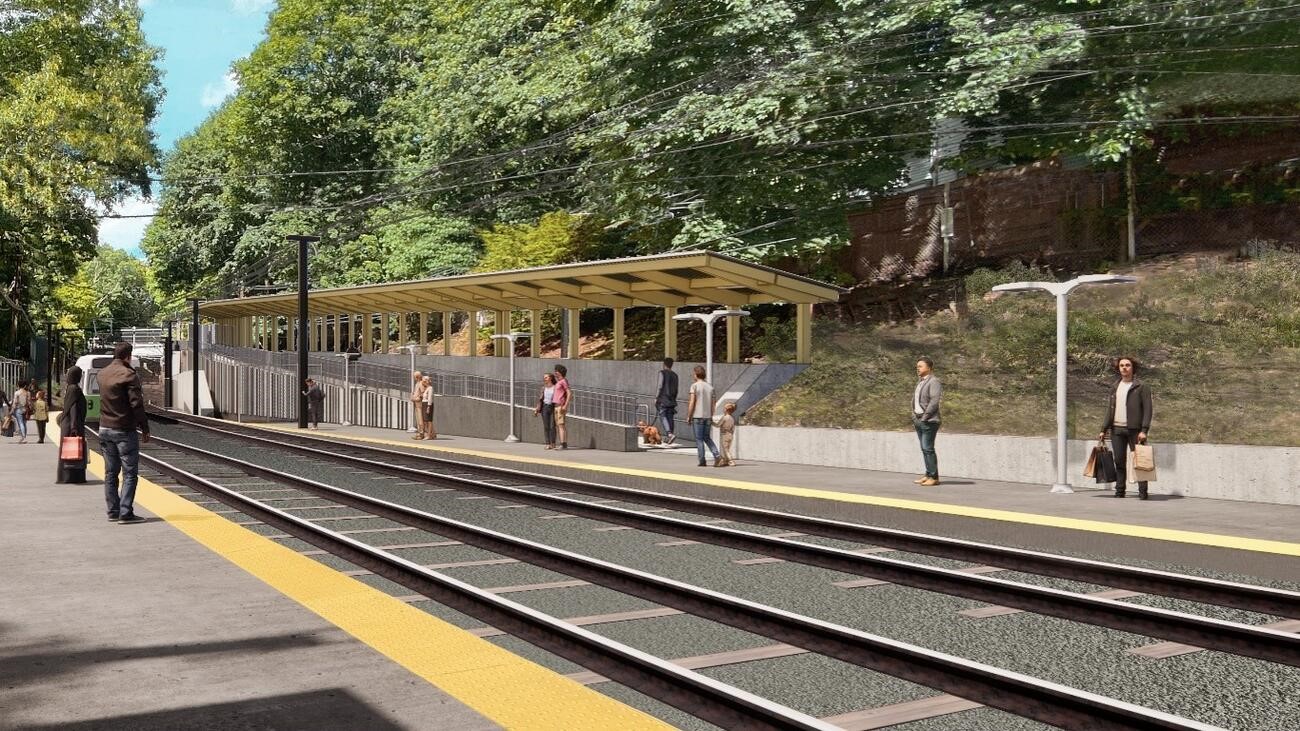
With Mott MacDonald’s program management support, the MBTA is making accessibility improvements at the Newton Highlands Green Line Station. (Credit: MBTA)
Addressing age-related SOGR deficiencies and accessibility challenges
Older stations are likely to have many original assets that are at – or beyond – the end of their useful life. Examples of common SOGR deficiencies include roof leaks, missing or damaged finishes, and outdated mechanical and electrical equipment.
Rehabilitation of older transit stations must also address a wide range of accessibility challenges. Many of these revolve around passenger boarding platform configurations and station access for individuals with disabilities.
It’s important to note that many SOGR problems also represent accessibility deficiencies. These may include missing railings, damaged walking surfaces, and excessive walkway slopes. Repairing these assets can be handled by the same types of skilled labor that deliver accessibility-related work. Simply put, accessibility and SOGR upgrade projects have a lot in common, and the Mott MacDonald team has worked with MBTA to bundle these into larger projects or programs. This approach is more efficient for the agency, as the corrective actions tend to be smaller than capital projects but no less cumbersome to engineer, procure, administer, and manage.
Efficient project delivery for major upgrades
The MBTA’s Green Line Transformation (GLT) is a portfolio program of ongoing projects to upgrade accessibility, safety, capacity, and rider experience on one of the oldest subway systems in North America. The GLT portfolio was originated to address various SOGR needs and technology and accessibility improvements across the Green Line. The program includes several construction projects to deliver major upgrades to Green Line tracks, signals, stations, facilities, and vehicles.
Mott MacDonald is supporting the MBTA with program management and project controls oversight of the GLT program. Program planning is key to prioritizing needs across the Green Line and to consolidate enhancements and corrective actions into specific projects. The resulting project scopes are tailored to efficiently use design and construction resources while meeting operational, program schedule, and budget considerations.
Platform replacements to support level boarding
Modern accessibility guidelines require that the height and configuration of a passenger boarding platform be coordinated with the floor of the transit vehicles it serves to minimize the vertical and horizontal gaps. Many older stations and vehicles do not meet this criterion because the platform height requires boarding passengers to step up into the vehicle and/or to walk over a wide horizontal gap.
The GLT program includes a series of projects aimed at transitioning to a new 100% low floor light rail vehicle (LRV) fleet and modifying stations to achieve 100% level boarding at all Green Line stations. Modifications include adjusting platform height to allow for step-free boarding at 8-inches above top-of-rail and planning for future modifications raising these same platforms to 14-inches above top-of-rail to facilitate level boarding for passengers. A multi-phase reconstruction of existing platforms along the route is needed to coordinate incremental replacement of the LRV fleet and the matching platform heights. For this reason, some stations are being provided with temporary platforms aligned with the LRV door locations.
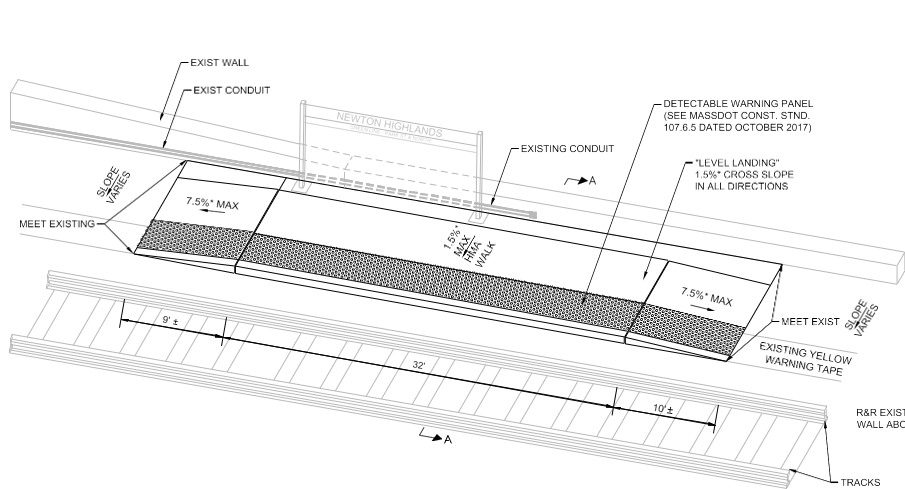
At Green Line stations, temporary raised platform sections provide incremental access improvements to serve the current vehicle fleet. Localized modifications like this must be carefully coordinated to minimize impacts to adjacent areas. Eventually, the full platform length will be rebuilt to be compatible with a new railcar fleet, providing a fully compliant level-boarding interface.
Incremental repair and reconstruction of transit platforms can be challenging. It’s relatively simple to identify individual locations where platform surfaces do not meet accessibility standards. But localized pavement modifications may “ripple out” and affect existing surface drainage and placement of existing entrances, shelters, stairs, lighting, signage, and other fixtures. A small adjustment in a specific location may trigger the need for further slope adjustments along the entire platform. During the design phase, the station architectural and engineering (A/E) team must keep a close eye on these situations and incorporate co-compliant upgrades in the construction documents where necessary.
Station access improvements
Public pedestrian access to a station must be via an accessible path that is traversable by individuals with disabilities. Pedestrian access routes must conform to specified widths, cross slopes, and running slopes so that they are usable without excessive effort by pedestrians using manual wheelchairs or other mobility aids.
The main accessibility improvements at the MBTA’s Green Line Newton Highlands Station include the construction of two new ADA-compliant pedestrian ramps to replace the existing steep and non-compliant footpaths. The proposed ramp also required design review to ensure that the project would not adversely affect the original 1886 depot building at the station, which lies in two National Register of Historic Places (NRHP) listed historic districts.
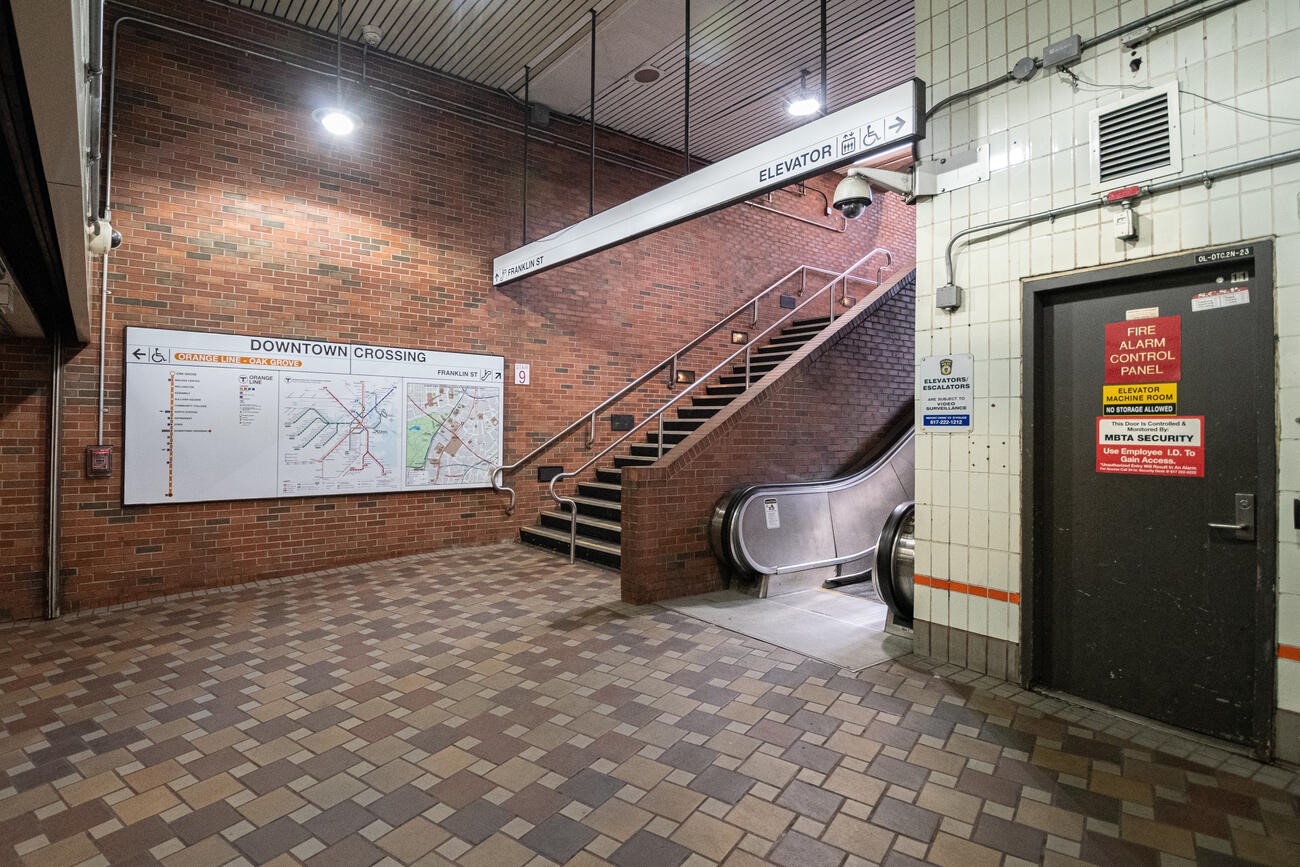
This entrance to the existing Downtown Crossing Station does not currently have elevators suitable for use by people with disabilities (Credit: MBTA)
Mott MacDonald is supporting MBTA with design and construction documents for new elevators to be installed at Downtown Crossing Station, one of Boston’s oldest subway stations and the nexus of the Red and Orange Lines. Adding new elevators in any existing station is one of the most challenging design and construction project types – new elevator hoistways need to fit and operate within tight quarters while avoiding conflicts with surrounding existing structural, mechanical, electrical, and fire protection infrastructure. For the Downtown Crossing project, an existing hoistway was enlarged to allow for a new stretcher-compatible elevator cab, integrating new technology and current practices. Moreover, passenger service on the Red and Orange Lines is planned to continue during construction, making the project even more complex.
Mott MacDonald’s experience with rehabilitation and expansion of existing transit stations provides transit station operators with thoughtful solutions to existing facility problems. These problems may represent accessibility compliance, SOGR-related deficiencies, or both. Our team also recognizes opportunities to improve your passengers’ experience with updated equipment and technology. We are here to help with individual stations or multiple-station programs that deliver benefits and make the best use of design and construction resources.


Subscribe for exclusive updates
Receive our expert insights on issues that transform business, increase sustainability and improve lives.