




Putting Moata Route Optimiser to the test
The combined challenges of climate change, population growth and increased urbanisation, alongside engineering constraints, are placing increasing challenges on the optimal route selection for linear infrastructure, often over greater distances.
We tested our Moata Route Optimiser (MRO) tool, which enabled a quicker and more efficient design, construction and operation of pipelines, reducing embodied carbon and whole-life costs to minimise environmental impacts both during the construction phase and for the life of the newly created asset.

Optimising the route of linear infrastructure is an inherently difficult task: each piece of infrastructure typically consists of multiple sub-systems, each interacting with one another in time and space. Each sub-system requires expert technical knowhow and engineers often rely on limited information on terrain, context and cost - particularly in the early phases of design. This means that the experts tend to be the optimisers. In these cases, human experience and intuition, underpinned by design rules often steeped in precedent, is relied upon to deliver a good solution.
In the early stages of pressurised pipeline design, this means looking at a map, drawing the shortest feasible line between the scheme’s end points that avoids any obvious constraints, then filling in the details afterwards and tweaking it as new information emerges. This inevitably limits the scope for real optimisation. If the human intuition misses the best solution from the start, or is based on learned assumptions that no longer hold true, the way back is difficult and costly.
We knew there was a better way of approaching this. What if we could leverage modern computing power to not only identify one feasible solution, but quickly find multiple interesting solutions that merit further investigation?
This is what our Moata Route Optimiser does.
To put MRO to the test, we devised a classic early stage design task for our engineers to solve. Using both traditional methods and the MRO, they were challenged to come up with outline designs for a water pipeline scheme from scratch. In doing so, they had to answer a key question that drives return on investment: ‘what are the quantifiable savings from using AI to the whole life costs of water pipeline assets?’
We considered three different hypothetical pipeline routes in East Anglia, UK, measuring between 15-35km in length and with daily flow rates in the order of 22 ML/d (0.25 m3/sec).
In the first instance, our engineers used freely available online GIS software to survey the terrain in the area between the start and end points, drawing a horizontal alignment based on experience and judgement from available aerial photography and then designing the vertical alignment.
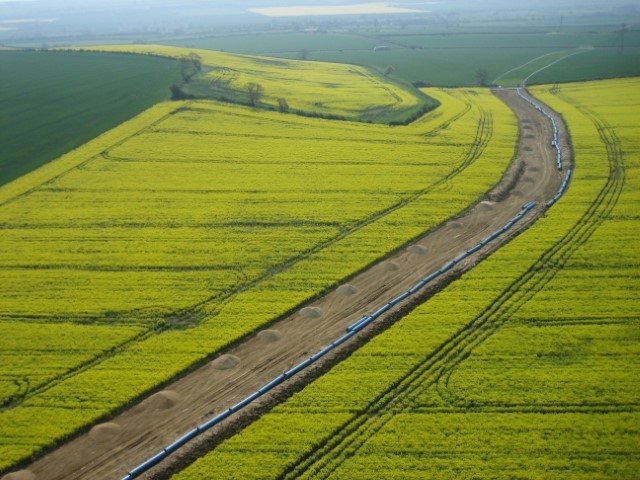
When using the MRO, the routes were assessed considering all constraints such as environmentally sensitive areas and linear crossings. Construction and operational costs were considered simultaneously to produce feasible solutions which can then be further refined.
Across the three scenarios, the MRO solution outperformed the conventionally determined route.
The test we ran identified the potential to save more than 10% of the infrastructure’s lifetime costs, which could equate to millions of pounds for major projects.
More significantly, it allows design teams to produce far more detailed design and costing outputs far earlier in a project and evaluate a much greater range of possible design options. This can save design teams up to 40% of the design time compared with traditional methods.
New information or data on real-world constraints can also be quickly incorporated to ensure any design can be adapted rapidly. The approach can be generalized and applied to any type of linear infrastructure, anywhere, such as roads, railways, power lines and other types of pipelines both onshore and offshore. Engineers simply need to break down their existing design process into a series of spatial constraints, design rules and applicable cost drivers with configurable parameters that can be used to guide the behaviour of AI algorithms.
The MRO approach is changing the way engineers work by shifting effort and time away from repetitive number-crunching and towards creative thinking and value engineering instead giving better information earlier to the decision makers. We truly believe this is the future for civil engineering.


Subscribe for exclusive updates
Receive our expert insights on issues that transform business, increase sustainability and improve lives.