
Expert insights on issues that transform business, increase sustainability and improve lives
Here’s a snapshot of what we’re thinking about. Explore these highlights or view the full library to dive deeper into the ideas shaping our work.
Meet some of our passionate problem-solvers, constructive creatives and inspiring innovators
The demand for data centres in the UK is expected to increase six-fold over the next decade, prompting interest in using nuclear power to meet this growing energy need sustainably.
Co-locating nuclear power stations with data centres presents legislative and logistical challenges, particularly around planning policy, population density and proximity to end users.
Industry collaboration is needed to provide research and evidence that could lead to future policy changes, potentially enabling nuclear power stations to be safely located near high-demand data centre sites.
Demand for data centres is growing and using nuclear reactors to power them is one way to ensure the increased energy consumption doesn’t affect the UK’s ability to deliver on net zero, while creating wider community benefits. Mott MacDonald development director for civil nuclear, Lewis McVey, outlines the challenges that need to be addressed to make the two technologies come together.
National Grid has forecast that energy demand from commercial data centres will increase six-fold over the next 10 years. When that growth is put in context of the number of data centres already in operation in the UK – a total of 523 – the scale of that energy demand becomes clear.
Given this expected increase, it is not surprising that hyperscalers such as Google, Meta and Amazon Web Services are looking to nuclear power; but co-locating nuclear power stations, whether conventional plants or small modular reactors (SMRs), with data centres requires careful consideration to overcome legislative hurdles. If these can be navigated successfully, the winners won’t only be the data centre owners and nuclear power developers – there are benefits for the communities around these new sites too.
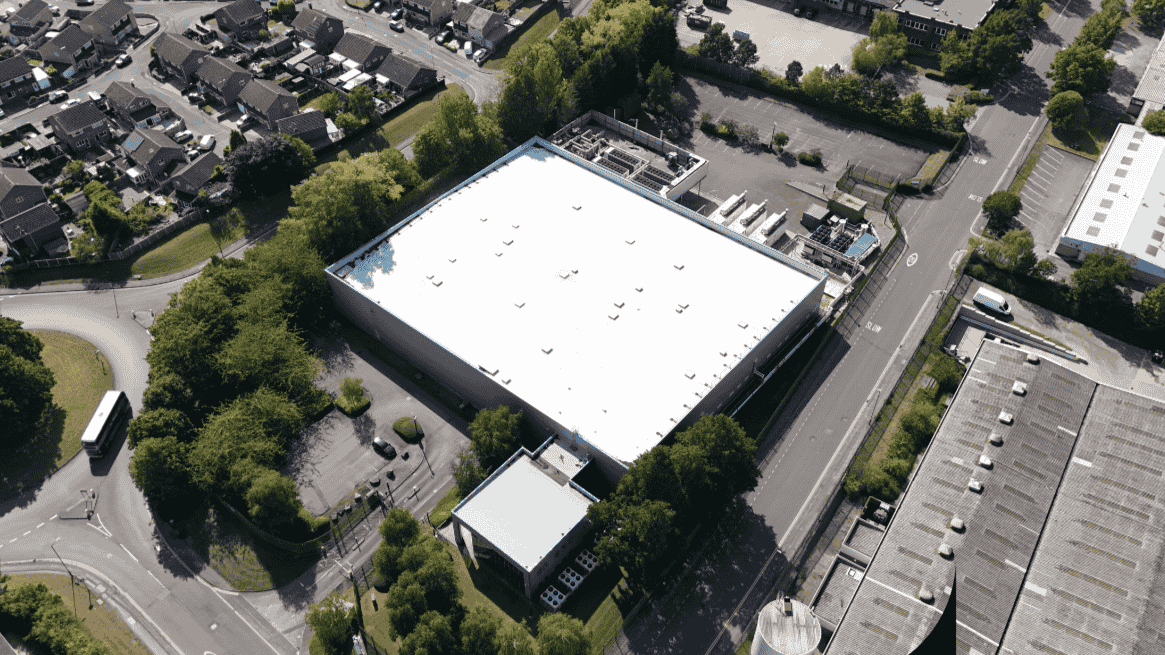
Designation of the new EN-7 planning policy statement for nuclear energy generation last month created new potential for co-location. Nonetheless, it will not be as straightforward as the headlines earlier last year stating that EN-7 would enable nuclear sites to be built “anywhere across England and Wales” suggested when the consultation was launched.
The UK’s current 523 data centres are mostly located around London, yet the country’s existing nuclear power plants are situated more rurally and close to water to meet cooling needs.
The population density and the proximity to the end user will be key factors in determining whether a data centre can be co-located with a nuclear power facility. Other important local requirements will include grid connection, cooling requirements, transport and logistic infrastructure, environmental sensitivities and the ability to attract and retain a local workforce.
A sticking point for the “anywhere” approach comes down to the population density criteria. EN-7 transferred the role of determining whether a proposed site satisfies the Semi-Urban Population Density Criterion from the Office for Nuclear Regulation (ONR) to the Health and Safety Executive. However, the industry urged that the criteria of less than 1,000 people per square kilometre within a 30km radius of the nuclear power station should be reviewed.
Mott MacDonald’s expertise of applying previous planning policy statements to projects including Sizewell C, Hinkley Point C and nuclear defence work was critical to providing feedback to the consultation, particularly around addressing the population density issue.
Responses from the industry to the EN-7 consultation highlighted a collective view that new nuclear technologies could be safely located closer to more densely populated areas with 68% calling for the semi-urban criteria on population density to be relaxed. In response, the Department for Energy Security and Net Zero (DESNZ) said that there was not enough evidence to demonstrate that the risk is significantly different for new reactors and it was therefore prudent to stick with the historic criteria. However, EN-7 leaves the door open for future updates with a review promised every five years once more operational and underpinning evidence was available.
New nuclear technologies could be safely located closer to more densely populated areas with 68% calling for the semi-urban criteria on population density to be relaxed.
This presents the industry with a fantastic opportunity to collaborate on research that could widen the potential for nuclear power stations to be safely located alongside data centres in areas where demand is high for their services.
SMRs in particular could be the perfect partner. Compared to traditional nuclear power stations, these reactors can be built with lower capital costs, shorter construction programmes, enhanced safety features and modular production. A typical SMR can generate around 300MW of consistent, carbon free, base load power and, like data centres, they can be developed in units, scaled up or down depending on demand.
Both data centres and nuclear power stations require cooling, which creates opportunities for thermal recovery. A 1GW data centre with an associated nuclear power plant could generate as much as 2.5GW of waste heat, enough to warm 300,000 homes. This could make a huge difference to deprived communities where the cost of heating takes up a large proportion of household income. Not only this, new clusters of data centres and power stations create jobs and secure massive inward investment, making them major regeneration catalysts. But maximising these benefits also requires collaboration between industry, local government and the communities affected.
With data centre owners looking to invest billions in the UK and renewed government commitment to nuclear power, the last 12 months has seen a lot of progress in this space; however, realising the full potential of this progress will call for industry collaboration to demonstrate that data centres can be powered safely and sustainably in the areas that need them most.
Sign up for our Nuclear Know-How webinar series, designed for those who are solving nuclear’s biggest challenges. In February, March and April you can learn directly from Mott MacDonald specialists and clients as they share actionable approaches, new digital tools, and insights shaping the next generation of nuclear projects.
Register below to access all webinars and live discussions.
To meet the UK’s nuclear clean-up and infrastructure goals, the industry must shift from reactive cost control to proactive, data-led planning that integrates decommissioning from the outset.
Discover how steel concrete composite structures are revolutionising modern construction methods for nuclear facilities, offering superior impact resistance and faster delivery. Learn about our research validating performance and building confidence in next-generation nuclear infrastructure.
A transformational new platform for structural design developed by Mott MacDonald is generating major savings in the nuclear sector, according to project director Desmond O’Malley and civil engineer Tom Holdsworth.
To lower lifecycle costs in the nuclear sector, facilities must be designed to anticipate future change, says Mott MacDonald technical director John Palmer.
Through immersive design validation and integrated planning, digital rehearsal drives efficiency and assurance in nuclear infrastructure delivery.
From concept to decommissioning, we’re designing nuclear assets for performance not just construction.
Ahead of the annual Women in Nuclear conference, two women from Mott MacDonald’s nuclear team discuss how the business’ inclusive culture is helping to drive change and the challenges that still exist.
2025 continues to evolve a complex geopolitical and economic landscape with shifting market focus and arguably increasing risks of supply chain disruptions affecting our US energy industry.
Civil nuclear power directly employs over 77,000 people in the UK and is worth £6.1bn to the economy, but the worth is so much more than that.
Meet Jim Grundy, our development director in nuclear. His career journey is one of adaptability, opportunity seizing and long-term growth outlook.
Zorica Ludzheva’s career path is anything but conventional. With a passion for solving complex design challenges, she’s progressed from industrial architecture to designing nuclear facilities and now has her sights set on space.
We recently spoke to Alexis Jourdain, our nuclear lead in France, about his career journey, what drew him to the nuclear sector and how he’s helping grow our presence in one of the world’s most established nuclear markets.
Mariam Thomas is a project manager working within the energy sector who returned to the workforce with a clear sense of purpose and a wealth of transferable skills after a five-year career break to raise her children.
We caught up with Harry to discuss how his role as a nuclear process engineer is helping the UK to meet its net zero targets and how he is supporting new graduates to follow in his footsteps.
Meet Julia Barr, a principal commercial manager, based in our Glasgow office, whose career path in our nuclear team is a testament to adaptability, self-belief and the power of supportive teams.
We caught up with senior process safety engineer Steven Melens to talk about his role in the nuclear civil and defence team within our UK and Europe energy business.
The Department for Energy Security and Net Zero (DESNZ) has awarded Mott MacDonald a contract to deliver technical advisory services in support of government oversight of the Sizewell C nuclear power plant on the Suffolk coast.
The Energy Market Authority (EMA) – responsible for regulating and developing Singapore’s energy industry – has appointed Mott MacDonald to conduct a study on advanced nuclear energy technologies for Singapore.
Mott MacDonald’s Julia Barr and Natasha Khan have been recognised in the Top 50 Women in Engineering 2025.
Mott MacDonald has appointed Alexis Jourdain to lead its nuclear division in France in the newly created role of project director, nuclear.
Rolls-Royce Submarines has announced the joint appointment of Mott MacDonald and AtkinsRéalis as its new fissile design partners – a key milestone in the expansion of its Raynesway site in Derby.
Mott MacDonald has supported Holtec Britain to complete the first step of the Generic Design Assessment (GDA) for its small modular reactor SMR-300 in record time.
Mott MacDonald has signed a Memorandum of Understanding with Holtec Britain and Hyundai E&C to further explore the delivery of Holtec’s Small Modular Reactor (SMR) technology in the UK.
Mott MacDonald, the global engineering, management, and development consultancy, has been appointed as the delivery partner for the Generic Design Assessment (GDA) of Holtec’s Small Modular Reactor SMR-300 in the UK.
Mott MacDonald has been appointed by Low Level Waste Repository Limited (LLWR) the UK's principal disposal facility for low-level radioactive waste, to supply project, programme and portfolio management services on an array of initiatives and projects at different stages in their lifecycle.
Mott MacDonald has been appointed by the UK Government’s Department for Business, Energy and Industrial Strategy (BEIS) to provide acceleration support for up to 200 small and medium-sized enterprises as part of the UK’s £1bn Net Zero Innovation Portfolio.
The new PALLAS-reactor will replace the High Flux Reactor located in Petten, Netherlands. The facility currently supplies around 30 percent of global isotope demand and is operated by the Nuclear Research and Consultancy Group (NRG) PALLAS.
Our design expertise and seamless digital collaboration are ensuring the Sellafield site will continue to benefit from effluent treatment that reduces risk from high-hazard nuclear material.
SMRs are nuclear fission reactors designed to be built at a smaller size, but in larger numbers than the world’s current nuclear fleet. They are cost competitive and considered to be more versatile, scalable, sustainable, financeable and efficient. With wider-ranging applications such as generation of industrial heat and hydrogen production, SMRs are well placed to help governments worldwide in achieving low carbon ambitions.
We provided project management services in conjunction with our partner Altran Technologies to the International Thermonuclear Experimental Reactor (ITER) International Organisation.
We designed and developed replacement processing facilities that will allow the safe and environmental disposal of nuclear waste from the naval base for decades to come.
The Nuclear Decommissioning Authority’s (NDA) digital vision supports more effective and informed decision-making by providing the appropriate information to the right people, improving how everyone works together and helping to undertake tasks more effectively.
We’re designing facilities that will help researchers in Belgium gain a new understanding of the use of radioisotopes for medical purposes and to explore the potential of nuclear fusion.
The safe storage (‘Safstor’) decommissioning strategy for the Bradwell nuclear site will enable the remaining buildings, plant, and equipment to be safely maintained and decontaminated to levels that permit release for unrestricted use.
The Paks nuclear power plant in central Hungary is the first and only operating nuclear power station in the country. We designed the repository required for safe management of used nuclear fuel and radioactive waste.
The 9/11 attacks in 2001 highlighted the potential for aircraft to be used deliberately to harm buildings and infrastructure. And with an ever-rising number of flights, the risk of accidental impacts was rising.
Our environmental assessment of the site ensures compliance with Environment Agency and Office for Nuclear Regulation requirements to protect people and the environment.
Supporters of small modular nuclear reactor (SMR) technology claim it could offer a range of benefits to the future energy system.
Receive our expert insights on issues that transform business, increase sustainability and improve lives.