




Spanning a century – presidential views on the evolving transport sector
Basil Mott was ICE president in 1924. His inaugural speech focused on the contribution of engineers to transport in London
His work centred on development of London's Underground and bridges
Today it is climate action, inclusion and infrastructure management that are pressing priorities
100 years ago Basil Mott put London’s transport at the heart of his ICE presidential address
2024 president for the Chartered Institution of Highways & Transportation, Professor Glenn Lyons, considers what has changed since that speech.
On 4 November 1924, Basil Mott – founding partner of one of the companies that formed Mott MacDonald – stood in the great hall at the Institution of Civil Engineers (ICE) and gave his inaugural address as president.
Revisiting his speech reveals that, despite the profound changes that have occurred in the last 100 years, some of the issues that London transport faced a century ago are still with us today. So too is the drive to advance progress.
A weight of responsibility
At the beginning of his speech Mott spoke of the weight of responsibility on engineers – to deliver socially beneficial and commercially successful projects, cost-efficiently but safely. And he contemplated the challenges that future generations of transport professionals would face.
Today’s industry and its professionals are grappling with challenges including ageing infrastructure, risks from climate change and the need for innovation to build less, build smarter and build more efficiently to help decarbonise the built environment while still supporting society’s needs.
Mott described engineers “upholding great traditions”. Many have endured such as a priority to safely, efficiently and affordably meeting society’s need. Engineering and innovation have always gone hand-in-hand. But it is important to question some traditions and how they sit alongside the need for being progressive.
In the present day, the transport sector has moved from addressing simple (though complex) problems to also addressing wicked ones. It has in turn seen the need for social science alongside the need for engineering and physical science.
Integrated transport
Mott focused on the challenges and accomplishments associated with the unfolding development of the ‘deep-level tube’ rail network. Among these, he bemoaned the “lack of foresight” in developing the network,
In his view, it was “constructed in a piecemeal fashion, in accordance with the ideas of individual promoters and their advisors, without regard to the interests of London as a whole”. Today, the need for integrated transport strategy is as important as ever in urban areas around the world.
But while trying to move more quickly forwards as a society, we are often too slow to look backward and draw on the advantage of hindsight.
Bus deregulation in the UK in 1984 allowed for the introduction of on-street competition for local bus services for the first time in 60 years.
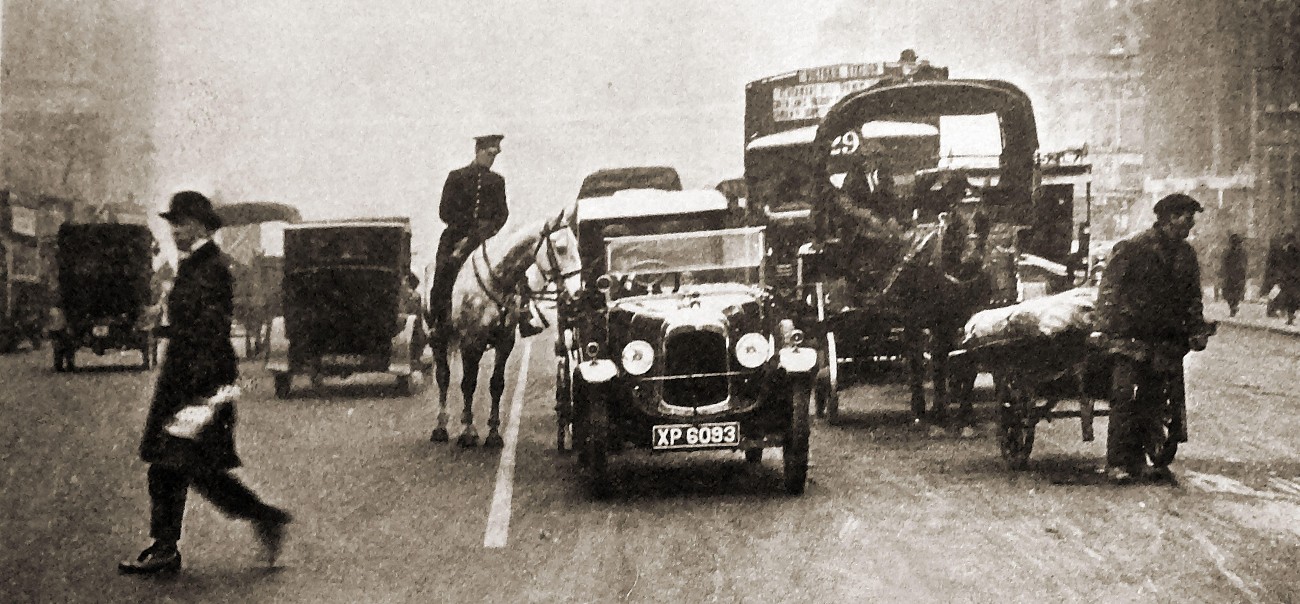
Yet allied to the first white line put down on a London street in 1924 and the introduction of traffic lights in 1926, Mott pointed to what might be done with traffic diversion and regulation and “restriction of unnecessary omnibus competition on special routes, which promotes congestion and in no way benefits the public”.
He may well have shaken his head in dismay at the turn of events in the 1980s and then the ‘corrective’ arrival of bus franchising several decades later.
Shaping society
Mott was acutely aware that even as engineers shaped transport systems to serve society, those systems were also shaping society – an understanding I articulated in my inaugural address as a new professor in 2003, yet one that is still frequently overlooked.
He noted that “although engineers do not usually claim to be traffic experts, the study of traffic requirements is not unimportant from an engineering point of view”.
It seems that induced traffic – whereby the creation of additional transport capacity generates greater demand – was on his mind: even as the tube network made fast, affordable transport available to the masses, traffic congestion at street level was increasing, Mott warned. He pointed to the need for “radical steps” in the immediate years ahead.
He contemplated, reluctantly it seemed, the radical step of creating new streets underground to accommodate more traffic, as a preferable alternative to them being overhead. But imagine what sort of London we would have now if the London Ringways – four concentric motorways orbiting the city centre and suburbs planned in the 1960s – had come to fruition.
Perhaps more recent developments such as congestion charging, cycling superhighways and digital substitution for travel would qualify as radical steps and meet with Mott’s approval.
An inclusive profession
While much of Mott’s address resonates today, it also has its anachronisms.
In 1924 he was regaling an audience exclusively of gentlemen. Engineering was indeed a man’s world, pushing forward significant infrastructural change. Women would not receive the same right to vote as men in parliamentary elections for another four years. It took 84 years before the ICE elected its first female president – 89 years in the case of CIHT.
Today we are able to embrace equality, diversity and inclusion in a way that was not conceivable 100 years ago. Thank goodness. Mott operated within the constraints and norms of his age, but embraced collaboration, supporting each other as professionals, and recognising the importance of diverse perspectives and roles in achieving successful projects.
I like to think he would approve of the progress being made on equality, diversity and inclusion. I like also to think he would approve of how our profession has developed, learning from where we have got things right, and wrong, while keeping our focus on delivering clear benefits for society.
And I am sure too that he would urge us to keep going.
About the author


Subscribe for exclusive updates
Receive our expert insights on issues that transform business, increase sustainability and improve lives.