




Breakthrough moment: HS2 completes 23 miles of deep bore tunnelling with Mott MacDonald support
An enormous boring machine being used to dig HS2’s Birmingham approach tunnels has broken through, marking the completion of major tunnel excavation between London’s Old Oak Common and the West Midlands.
The 125m long tunnel boring machine (TBM), named Elizabeth after the 19th century philanthropist Elizabeth Cadbury was launched near the Warwickshire village of Water Orton in March 2024. It arrived at Washwood Heath on Monday 13 October.
Two identical machines were used to dig the 3.5 mile long Bromford tunnel that will carry high speed trains under the M6 and eastern outskirts of the city, with the first one, Mary Ann, breaking through earlier this year.
Together, Elizabeth and Mary Ann have excavated more than 1.8M tonnes of material and installed 5804 concrete ring segments for the twin, eastbound and westbound tunnels. The spoil, made up of various grades of Mercia Mudstone, is being used to landscape the railway on the approaches to the city.
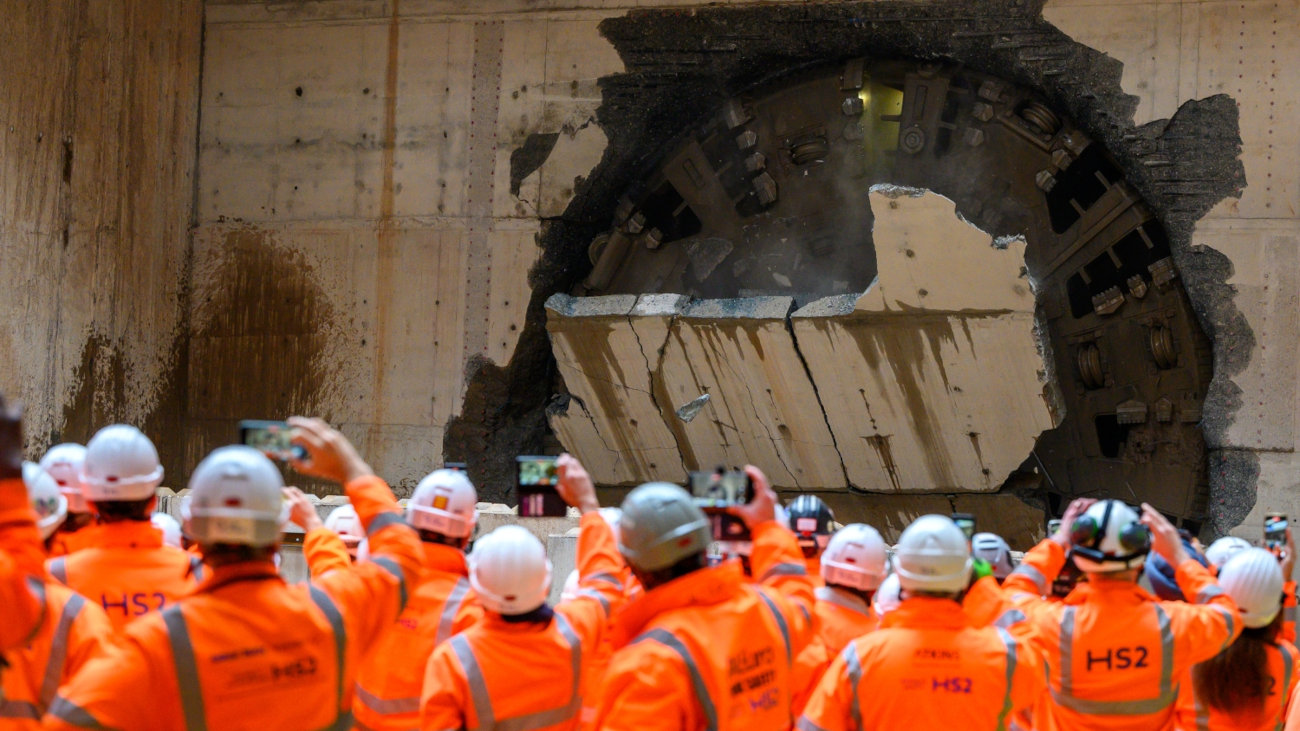
This milestone means that all the excavation is now complete for the 23 miles of deep bore tunnel between Old Oak Common in west London and the railway’s terminus at Birmingham Curzon Street. Construction teams are now mainly focused on internal walkways, ventilation shafts and cross passages.
Once complete, HS2 will improve journeys between the UK’s two largest cities while freeing up space on the existing West Coast Main Line for more freight and local services.
Alan Morris, HS2 Ltd’s construction delivery director said: “Today’s breakthrough is a major milestone for the tunnelling team here in Birmingham and for the HS2 project. All eight of the TBMs digging our tunnels between Old Oak Common and Curzon Street have now broken through, which means that the focus is now on the internal concrete work, ventilation shafts and cross passages.
“I’m immensely proud of the men and women who have worked round the clock to bring our TBMs and their crews home safely, and I look forward to seeing more progress inside the tunnels in the years ahead.”
Each TBM is an underground factory – working 24/7 to excavate, install the concrete ring segments that form the walls and grout them into place as it moves forward at an average speed of around 10m per day.
Eight TBMs have been used on the project so far, with an incredible 9.4M tonnes of material excavated during their tunnel drives. The longest tunnel, under the Chilterns, stretches for 10 miles, while the Northolt tunnels run for 8.4 miles from West Ruislip to Old Oak Common in west London. Additionally, there is a short one mile twin bore tunnel beneath Long Itchington Wood in Warwickshire.
Two more TBMs are expected to launch next year to begin digging the tunnels from Old Oak Common to HS2’s final destination, London Euston.
A short section of mined tunnel is also being dug between the Victoria Road Crossover Box and Old Oak Common.
Alongside these deep tunnels, HS2 is also delivering around five miles of shallow ‘cut-and-cover’ tunnels in rural areas such as Burton Green in Warwickshire, Chipping Warden in West Northamptonshire and Wendover in Buckinghamshire.
We’re proud to have played a leading role on HS2’s major tunnelling programme – having started initially with their design and continuing through to today’s construction support. It’s remarkable how frequent these milestones have now become, and they reflect the dedication of the teams driving progress. The Mott MacDonald SYSTRA Design Joint Venture, working on behalf of Balfour Beatty VINCI are now focused on what comes next – exiting these tunnels and driving the next phase of delivery.Rosa Diez
Tunnels practice leader, Mott MacDonald
The Bromford tunnel is being delivered by HS2’s main works contractor Balfour Beatty VINCI (BBV) with a team of more than 450 people involved in the complex logistical operation required to keep the TBMs moving around the clock.
During their year-and-a-half-long mission, the team on board the 1600 tonne machines worked at depths of up to 40m. They skilfully navigated Elizabeth and Mary-Ann under the M6 motorway, key National Grid infrastructure and the meandering River Tame, which they crossed four times, with a headspace as low as five metres.
Meanwhile, separate teams were focused on supplying the concrete ring segments and removing the spoil as well as beginning work on the cross passages and the ventilation shaft at Castle Vale.
With the breakthrough complete, Elizabeth will now be removed from the tunnel to allow work to progress on the concrete finishing works, base slabs and emergency and maintenance walkways.
Jules Arlaud, Balfour Beatty VINCI’s tunnelling director, said: “Today is a historic moment for Balfour Beatty VINCI, as TBM Elizabeth completes her three-and-a-half-mile journey in Washwood Heath. This is BBV’s fourth and final TBM breakthrough, delivered by our expert tunnelling team who’ve worked around the clock over 19 months to arrive at this point.
“A sense of achievement and pride is felt by everyone connected with the project and follows years of planning and preparation. This has allowed us to guide Elizabeth safely and successfully underneath complex ground conditions and critical live infrastructure, including energy networks, the M6 and the River Tame. A breakthrough is always a unique moment, and it marks the culmination of exceptional engineering, dedication and collaboration.”
As well as being the arrival point for the two Bromford tunnel TBMs, Washwood Heath will also become the nerve centre for HS2’s operations. Next to the tunnel portal, HS2’s Depot and Network Integrated Control Centre will be built. From this site, trains will be serviced and stored, and the real time operation of the railway will be controlled.
Washwood Heath is one of three key HS2 sites in the West Midlands, alongside the two new stations that will be built in Birmingham and Solihull. Collectively, the three sites have become a magnet for property investors and developers, helping to drive multibillion-pound redevelopment projects in the areas nearby, which are forecast to add £10bn to the region’s economy over the next 10 years.


