




Mott MacDonald appointed to world-first commercial scale liquid hydrogen and liquid CO2 terminal in Amsterdam
Mott MacDonald, the global engineering, management and development consultancy, has been appointed as owner’s engineer for the pioneering EcoLog Terminal Amsterdam, the world’s first commercial-scale facility designed to import liquid hydrogen (LH₂) and export liquid CO₂ (LCO₂).
As owner’s engineer, Mott MacDonald will provide multidisciplinary oversight across planning, design and construction, verifying that the project meets the highest standards of quality, safety, efficiency and delivery performance. It will also undertake independent assurance of design deliverables, support risk management activities, confirm technical designs and assure project progress. The company’s vast portfolio in the Netherlands make it well attuned to the Dutch market.
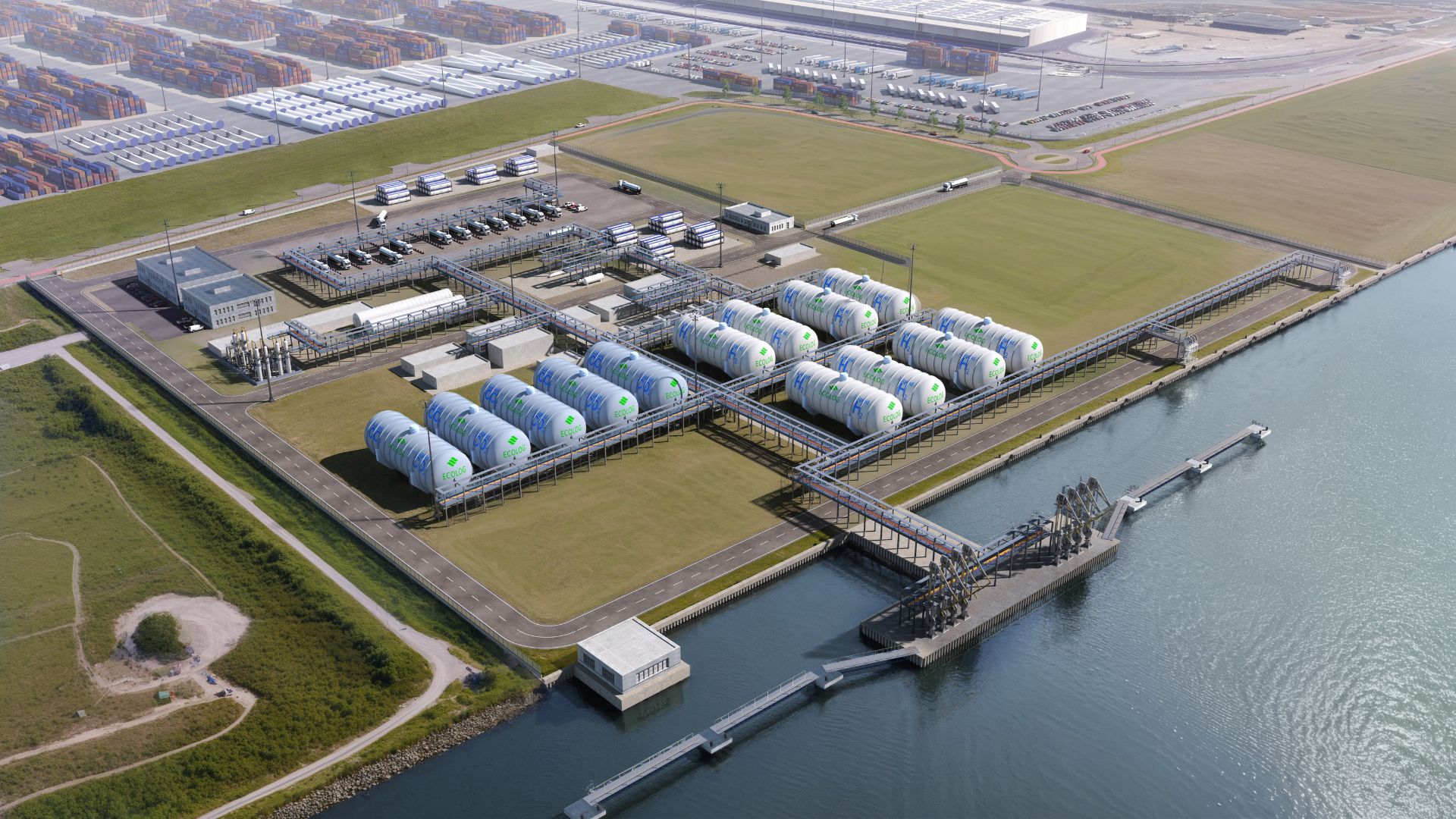
EcoLog’s terminal is being developed in the port of Amsterdam, the Netherlands, and, complemented by EcoLog’s purpose-designed LH₂ vessels, will be a key part of newly emerging global energy supply chains. The first phase of the terminal is expected to be completed by the end of 2030, with initial annual throughput capacity of 200,000 tonnes LH₂ and 1.8M tonnes LCO₂. This can subsequently be expanded to 600,000 and 4.25M tonnes, respectively.
The dual-purpose EcoLog Terminal Amsterdam is designed as an open-access, third-party terminal. It will enable largescale import, storage and distribution of both gaseous and liquid hydrogen for industrial and mobility applications across Northwest Europe. In a unique design feature, the terminal will use the cold energy released during LH₂ regasification to liquefy the CO₂, improving overall energy efficiency and reducing operational emissions. The terminal will boast multiple transport modalities, including two hydrogen pipeline connections (high and low-pressure), a CO₂ pipeline connection, a truck loading facility, a barge jetty and a rail connection. The facility will function as a logistical axis to distribute imported hydrogen to destinations in the region, elsewhere in the Netherlands and neighbouring countries, while also consolidating CO₂ flows for reuse or overseas permanent storage.
We are really pleased to apply our technical expertise to this breakthrough project.
Claudio Tassistro, managing director of energy, Europe, Mott MacDonald said: “We are really pleased to apply our technical expertise to this breakthrough project, which will connect hydrogen producers in regions with abundant low cost renewable power to growing demand across Europe, accelerating the shift to cleaner energy systems and supporting decarbonisation across multiple sectors. The project is paving the way for a pipeline of projects we are involved in, linked to cryogenic low carbon fuels.”
Ellen Ruhotas, ceo of EcoLog, said: “The expertise, experience and, most of all, personal touch that the Mott MacDonald team brings to the table make it a strong addition to the project. The EcoLog Terminal Amsterdam seeks to make a large contribution to the decarbonisation of sectors like steel manufacturing, heavy duty road mobility, maritime transport and data centres, among others. With Mott MacDonald on board, we feel confident we can bring this vision to realisation.”
Front-end engineering design on the EcoLog Terminal Amsterdam began in January this year, with the terminal expected to be operational by the end of 2030. It will become the first of its scale globally, forming a foundational link in emerging European and international networks for green hydrogen and CO₂.


