




Taking a programmatic approach to save time and cost on military airfield renewals

Project overview
Lessons learned from renewal of the runway at RAF Lossiemouth in Scotland in 2021 have benefitted the recently completed runway refurbishment works at RAF Leeming. Through adoption of a programmatic approach for the first time, the Defence Infrastructure Organisation (DIO) has combined the experience gained from both schemes and is now rolling it onto the next projects.
“Overall, the runway surface upgrade at RAF Lossiemouth went really well but there were some initial teething issues that the client DIO, VolkerFitzpatrick as contractor and Mott MacDonald as design consultant recognised could have been addressed better with earlier engagement on the design and construction,” explains Simon Nesbitt, who is Mott MacDonald client director for VolkerFitzpatrick’s parent company VolkerWessels. “The main issues were around the scheduling of the works on site.”
As an example of the challenges Simon points to how the design was developed based on the RIBA Stage 3 design and associated phasing, however, there were instances where this phasing, once discussed with the station, did not work for operations. While some of the alternative phasing proposed by VolkerFitzpatrick resulted in programme savings, Early Contractor Involvement (ECI) could have resulted in further refinement of the programme to deliver time and cost savings too.
The runway upgrade at RAF Lossiemouth was a conventional standalone project to renew the airfields, taxiways and aeronautical ground lighting (AGL) as part of a £500M programme to improve the airbase. Nonetheless, it was a turning point for how DIO approached other runway projects. The experience supported the case for the DIO to develop the Airfield Operating Surfaces Programmatic Approach (AOS-PA) framework to deliver future renewal work in order to bring the benefits of ECI to a pipeline of work.
Experience gained at Lossiemouth showed that ECI would have driven benefits across all project elements. As an example, Simon says that in undertaking surveys to inform the works, surveying to the correct level of detail once, rather than in stages, means that the design team could have reached the appropriate design solution more quickly and efficiently resulting in more effective handover processes.
“In the past, the DIO had condition reports for all airfields and work was prioritised using that list, but it was a reactive, rather than a proactive approach,” explains Simon. “By creating the Strategic Alliance Partnership, the DIO took a more holistic approach and started to develop a pipeline of work so that lessons learned on the design and programming of individual projects could be taken from one scheme to the next. It also meant that project teams could be kept together rather than being formed for each individual project and then disbanded as there wasn’t another scheme to move them directly onto.”
By working collaboratively with VolkerFitzpatrick and restructuring our design schedule, we were able to prioritise design packages in line with the construction programme to maintain construction operations.
The initial AOS-PA framework started in late 2022 and ran for three years, with the uptake of the two year extension option approved in spring 2025 enabling the alliance contract to continue to deliver a rolling programme of work until 2027. VolkerFitzpatrick and Lagan Aviation and Infrastructure were the successful contractors appointed to the framework in 2022. AS part of that, Mott MacDonald is providing design services for VolkerFitzpatrick for its work on RAF Leeming, RAF Brize Norton and RNAS Yeovilton.
The AOS-PA is a priority initiative for DIO and the long-term objective is to improve whole life management of airfields, which are critical military assets. DIO has said that this will emerge from proactive pipeline management and the benefits of long term delivery contracts delivered over several lifecycles of the Strategic Alliance Partnership using the asset condition analysis and early project scoping work approach.
The first project delivered by VolkerFitzpatrick and Mott MacDonald under the AOS-PA was the upgrade at RAF Leeming in North Yorkshire, which handles around 22,000 aircraft movements each year. The timing of the bolt hole – a period of relocation of airfield operations offsite to enable the construction work – had already been set before the AOS-PA was established so the lead time for the design work was condensed.
According to Mott MacDonald project director Chris Arner, this timescale challenge demonstrated the benefits of the framework by combining the experience from RAF Lossiemouth with the collaborative approach of the AOS-PA. “If we didn’t hit the four-week bolt hole, the surfacing work would potentially have to wait until the following year,” explains Chris. “By working collaboratively with VolkerFitzpatrick and restructuring our design schedule, we were able to prioritise design packages in line with the construction programme to maintain construction operations.”
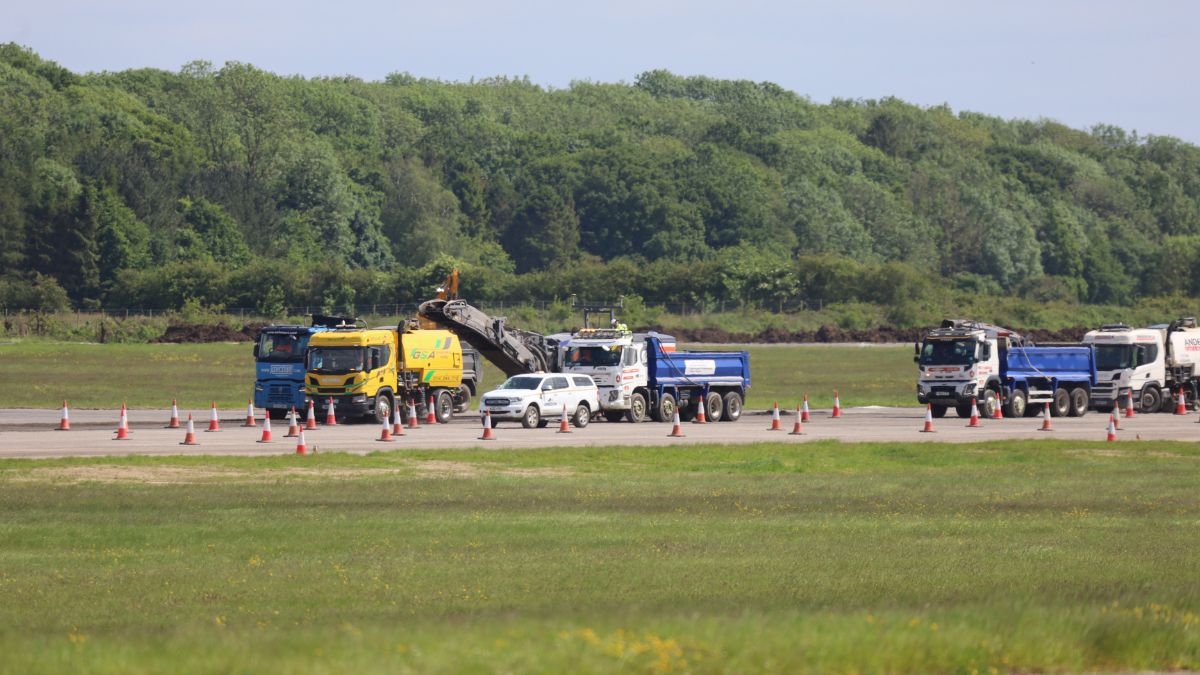
Despite the tight schedule, as well as receiving a late change in asphalt specification, the £59M scheme, which involved 33,500t of asphalt resurfacing, has now been successfully completed.
“One of the key learnings we took away from the work at RAF Leeming that is now feeding into other projects is that every airbase is different and the AGL on bases developed in the 1940s for World War II often need more extensive upgrades to meet modern regulations,” says Mott MacDonald principal client manager Mark Baynham. “We are now undertaking multiple surveys at the same time and at an earlier stage to streamline the design to make it more efficient and undertaking discussions with stakeholders at the same time.”
According to Chris, this approach has led to a more robust programme and greater cost certainty for the work on RAF Brize Norton for which the RIBA Stage 3 design has now been completed. Construction is planned to start in 2026.
“We have a 16-week bolt hole for RAF Brize Norton, which is critical for us to hit as the relocation costs for the aircraft and personnel is high and delays would potentially be very disruptive to military capabilities”
Simon adds: “The scheduling of the bolt hole was pre-determined at RAF Lossiemouth and RAF Leeming but we worked with VolkerFitzpatrick, together with DIO, the RAF and station stakeholders, to plan for it at RAF Brize Norton. This joint working is one of the benefits of the AOS-PA – it brings confidence and removes risk.”
The goal is to have two projects running simultaneously, with a third overlapping slightly.
The overall construction programme at RAF Brize Norton will take 14 months to complete. The work includes a full runway refurbishment, resurfacing of taxiways and existing stands, plus design and construction of four new stands, as well as new drainage, AGL and approach lighting.
“In total we are expecting to be placing 129,000t of new asphalt during the work,” says Chris.
Another improvement that the team is aiming to take from RAF Leeming to RAF Brize Norton and RNAS Yeovilton is the use of machine learning on the asphalt planers to improve efficiency by achieving the right surface profiles more quickly. According to Mark, the approach can also help improve the optimal milling depth straight from the digital designs to avoid removing excess material. Through the re-use of material and a proactive approach to carbon management throughout the design stage, RAF Leeming was able to achieve a “very good” BREEAM rating, exceeding the target of “good” set for the project.
Under the AOS-PA, all the knowledge from the work so far is being rolled onto the design work for RNAS Yeovilton in Somerset for which the detailed design is now underway.
“The goal is to have two projects running simultaneously, with a third overlapping slightly,” he says. “The overlap is key to keeping the project teams together, which is the essential element to maximising the potential benefits of the AOS-PA.”


Subscribe for exclusive updates
Receive our expert insights on issues that transform business, increase sustainability and improve lives.