




Unlocking data-driven planning with computer vision AI
Project overview
After standing tall for over 200 years, the oldest tree in Glasgow’s Botanic Gardens had to be felled in August 2022. A weeping ash planted in 1818 had fallen victim to a devastating fungal disease known as ash dieback, which had left it in a dangerous condition. Sadly, this was not the only tree affected. Ash dieback is currently sweeping across Europe costing landowners billions of pounds to clear the dying trees, as well as removing the air quality and biodiversity benefits that the trees provide.
One of the biggest concerns is the impact on linear infrastructure such as highways. Falling trees present a major risk to drivers and for this reason Glasgow City Council appointed Mott MacDonald to investigate the risks posed by ash dieback on the city’s highways.
Rather than conduct thousands of hours of labour-intensive manual surveys, Mott MacDonald had been working on a new, state-of-the-art, AI-powered system for identifying and analysing diseased trees. This had already proved successful for several local authorities in the UK, but was optimised on the project in Glasgow. By combining the domain expertise of its experienced arboriculturists and surveyors with intelligent data analytics from its central digital team, Mott MacDonald has created a new platform that automatically detects ash trees, assesses their status and identifies risks to highways.
“Our system uses vehicle-mounted cameras and advanced computer vision to automatically detect ash trees, assess their health, and geolocate them - all at traffic speed,” explains John Farrow, digital project principal at Mott MacDonald. The new method enables rapid, safe, and scalable surveying without the need for traffic management or manual inspections. “It is fundamentally a different way of doing this work and it is changing the way that local authorities are managing risk.”
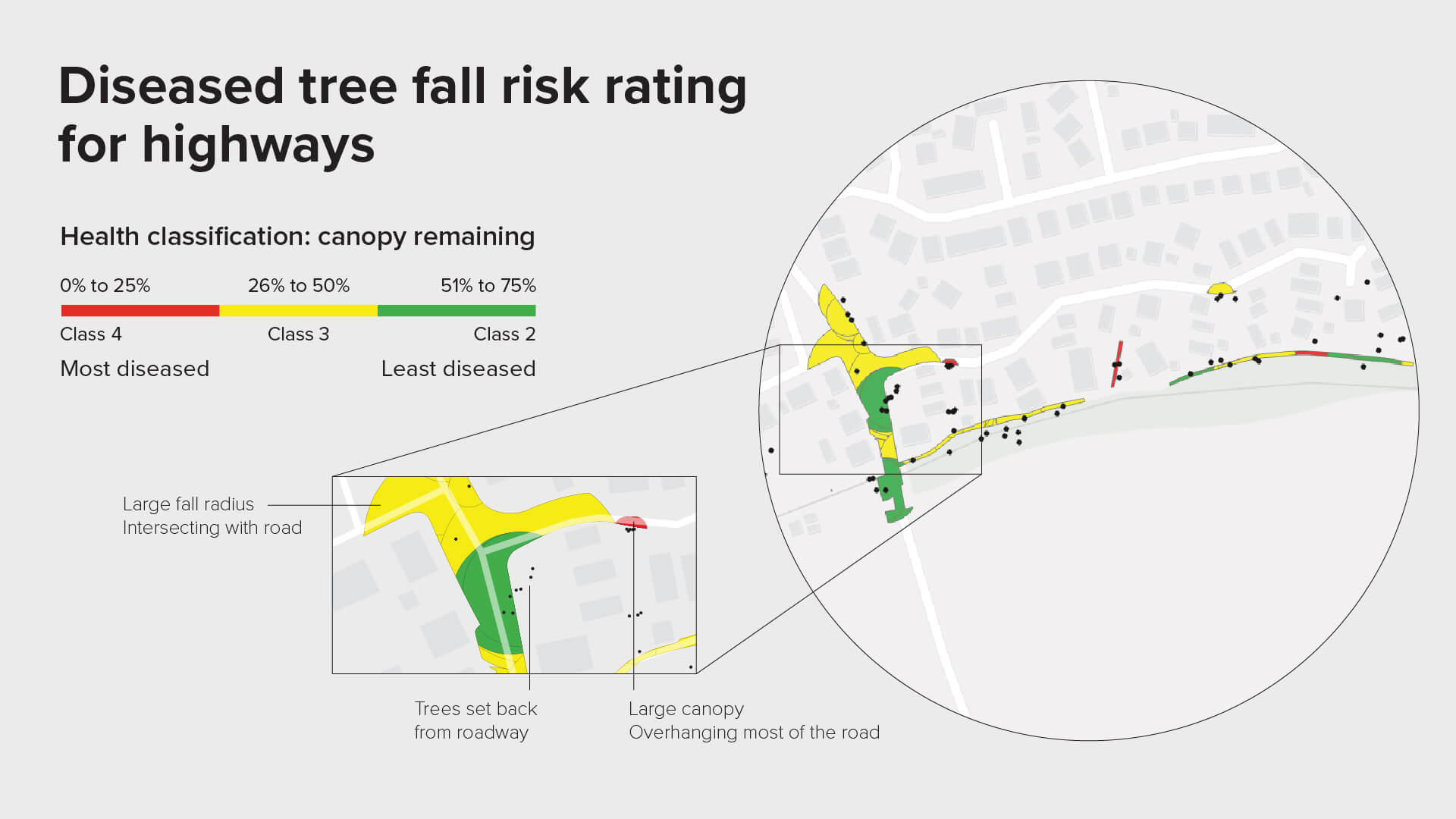
Example of how data can be used to classify the fall risk rating for local roads
Government push for AI
This is an important development as the UK government has repeatedly challenged the public sector to rapidly pilot and scale up AI products and services. Originally in its AI Opportunities Action plan published earlier this year the call is also repeated in the AI Playbook for the UK Government. Where it states that harnessing responsible AI offers an unparalleled opportunity for public sector efficiency, specifically doing things differently and delivering more with less.
Glasgow City Council has certainly risen to this challenge. The new AI based tool has provided data that it has never had before, enabling it to prioritise its actions by taking a long term, risk based view of the impact of ash dieback on its highways network. This in turn has led to the identification of new sustainable revenue streams as the pipeline of felled trees is sold to local businesses, turning an arboriculture crisis into an opportunity.
The first step in the Glasgow project was demonstrating to the city council that the system worked, which meant explaining it in a transparent way, before testing it on a small length of highway. This began with helping the council to understand how the system was developed and quality assured.
Integrity testing
Tom Doughty is a digital project manager who began working on the computer vision approach back in 2020, initially delivering an ash survey on over 500km of highways for the North and Mid Wales Trunk Road Agent (NMWTRA) through manual review of days long video capture. “We had been developing computer vision for things like structural defects and then we were presented with this use case in North Wales. We could see that there was a huge opportunity to use this technique,” he says.
But AI is only as good as the data that feeds it, and the expert users that oversee and validate it. “My job was to review thousands of images and put a square around anything that was an ash tree,” says James Southcott, senior arboriculturist at Mott MacDonald. Initially images were recorded with Go Pro cameras mounted on cars, but this has since evolved into the use of 360 degree, geolocated image capture. “Training the algorithms tends to be laborious at first but gets better and faster as it learns.”
It wasn’t perfect though. So James and his team kept validating the model outputs, before reviewing and retraining the model. “Sometimes it would get things wildly wrong. For some reason it really enjoyed traffic lights and identified them as ash trees.”
The arboriculturists also found that each time the system was used in a new location a significant amount of retraining had to be done. “Because it learns by crunching raw data we have to think about what is different in each place, the light aspects, the topography, the buildings.”
Once the team were confident that the system was correctly identifying ash trees they then taught it to classify the health of the tree using the classification system recommended by the Tree Council. Affected trees lose their canopy over time. Class 1 is still relatively healthy with 76-100% cover, progressing to Class 4 where it has less than 25%. “It generally kills trees from the top down, and from inside out meaning you can see it losing its cover at the crown and at the tips,” says James.
Once again, the arboriculture team continued to quality assure the images to confirm that the model was matching the judgement that they would make. At times this included site visits to provide further validation.
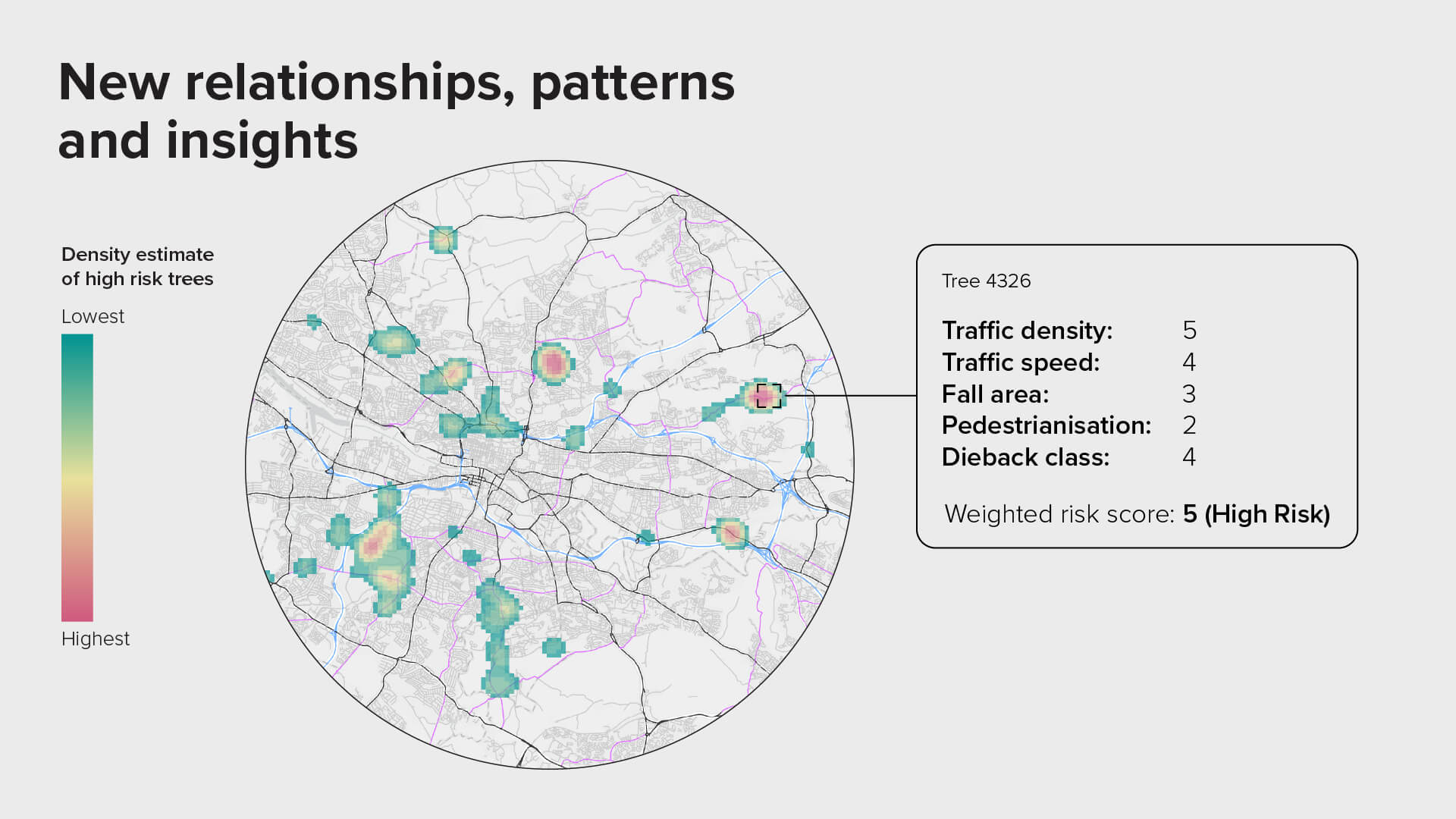
Example of how the data can identify areas with a greater density of high risk trees
Passing the test
With Glasgow City Council fully aware of the methodology, its advantages and its limitations the team delivered a 10km pilot study to the council. The findings were then tested in a ground study carried out by the council itself. “The results were really good,” says Tom. “It was around 84% accurate and so much faster than manual surveying.”
The team got to work and in just a matter of weeks Mott MacDonald’s computer vision based AI system had surveyed all of the city’s highways, identified over 13,000 ash trees, classified their health and importantly using the geolocation data and tree height to determine how close they were to the highway. For the first time ever, the city had a complete picture of the risks in the short, medium and long term.
“The outputs from the system informed a proactive risk-based strategy that enabled the council to prioritise its interventions and repurpose the felled timber through local supply chains,” says Gavin Jackson, project manager (ash dieback) and arbor operations at Glasgow City Council.
This not only reduced waste but supported Glasgow’s circular economy ambitions, transforming a cost burden into a sustainability opportunity. The council estimates that reselling the timber equates to over 115 tonnes of CO₂ saved compared to disposal via recycling partners.
What is even more impressive is that Glasgow City Council estimates that the digital approach has generated over £500,000 in savings through automated surveys and strategic planning - enabled by the system’s speed and scalability. Impressive enough that the Glasgow Chamber of Commerce named it the best use of digital technology in its 2025 awards.
Transforming future surveys
“Computer vision allows our domain expertise to go much further. Traditionally our aboriculturists can cover a few km of road in one day. Now we can capture hundreds of kilometres,” says John Farrow, explaining that the system has so far helped nine local authorities and demand is growing. “There is nothing like this in the industry at the moment. It sets a new benchmark for digital tree management and there are huge opportunities to transfer the underlying technology into other applications.”
Experts from Mott MacDonald are already investigating ways in which they can fuse their unique domain knowledge with computer vision to provide even better services to clients. These include applications such as pavement defect monitoring, structural health assessments, and site safety supervision. “With specialists across every facet of infrastructure and a dedicated digital team skilled in AI and data science, we are uniquely positioned to integrate technical knowledge with cutting-edge technology. This fusion enables us to tackle some of the industry’s most complex challenges with precision and purpose," says John.


Subscribe for exclusive updates
Receive our expert insights on issues that transform business, increase sustainability and improve lives.