




Infrastructure as a catalyst for change
The UK government recently announced new investment in local transport, including £2.4bn for the West Midlands
The West Midlands is brimming with opportunities but this must be carefully and collaboratively planned to ensure that the benefits are maximised
Understanding the key enablers that will drive growth in the region is essential
A powerhouse of potential
The West Midlands is on the brink of transformational change with infrastructure as a catalyst for rebalancing economic inequality, says Mott MacDonald project director for buildings, South, Midlands and Wales, Tim Fawcett.
Today the West Midlands is a powerhouse of potential with a new high speed rail connection under construction and internationally renowned sporting development to major investments in healthcare, manufacturing, commercial and leisure space. The entire region is brimming with opportunities, but this must be carefully and collaboratively planned to ensure that the benefits are maximised in communities that need them the most.
Following the Government’s announcement on 4 June to double investment in local transport across England’s city regions over the next five years, it’s an opportune time to reflect on the scale of ambition in the West Midlands and some of the key enablers that are driving growth in the region.

Network connectivity
Earlier this week, the Government announced £15.6bn of investment for local leaders to drive cities, towns and communities forward. This includes £2.4bn allocated to the West Midlands. One of the priority investments for this funding is likely to be a metro extension connecting Birmingham City Centre to Birmingham’s new sports quarter, enabling the Mayor to kick start his ambitions to deliver mass transit from East Birmingham to North Solihull.
Improving public transport is a powerful way to redress economic imbalance and this is particularly important in the area between East Birmingham and North Solihull - also known as the EBNS corridor - where some 375,000 people live. Poor connectivity is a key contributor to high rates of unemployment and low access to healthcare and educational opportunities. Statistics from the West Midlands Combined Authority show that 72% of wards in the EBNS area fall into the top 10% most deprived wards in England, particularly East Birmingham which has the highest rates of deprivation outside of London. But the good news is that well planned public transport has the power to change this for the better.
Working for Transport for the West Midlands in collaboration with Birmingham City Council and Solihull Metropolitan Borough Council, Mott MacDonald has been investigating the best form of mass public transit to improve connectivity along this corridor. Importantly we are also identifying further improvements to the network that would make this rapid transit system even more accessible for local communities where car ownership rates tend to be low. In some areas less than 50% of households have access to a vehicle – and yet many streets have significant challenges with congestion and parking. Network improvements are therefore vital to ensure people have access to the new opportunities coming to Birmingham, many of which are at either end of this transport corridor.
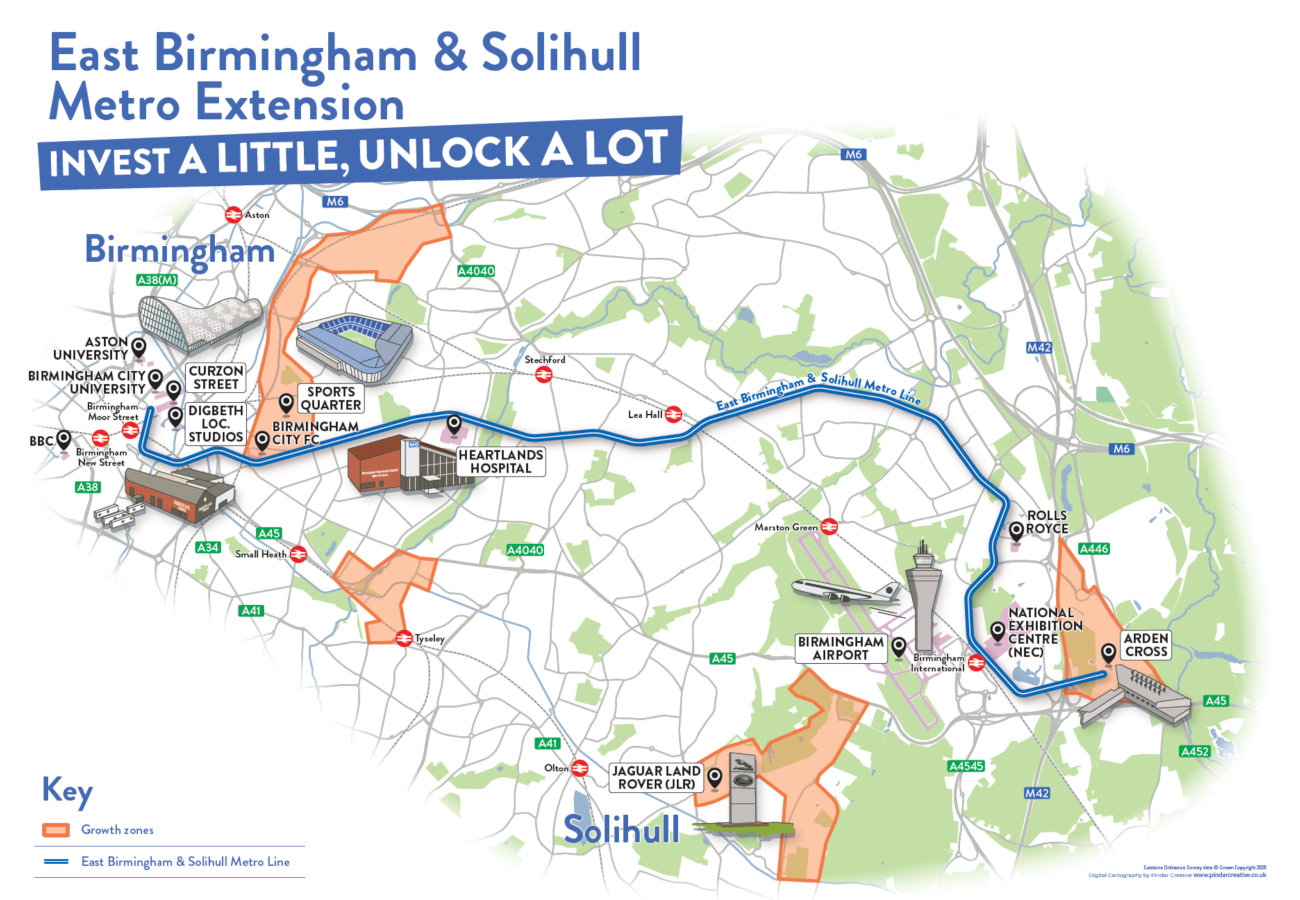
Image source: West Midlands Combined Authority
Raising ambition
At its eastern end, near Birmingham Airport, the HS2’s Interchange Station will have a catalytic effect on the area. To support local authorities to make the most of this opportunity Mott MacDonald has worked on a range of studies. The most recent of these has seen the business working with partners on the Arden Cross masterplan, which encompasses the 140ha of land around the new railway station.
The vision at Arden Cross is to create a sustainable economic hub, where high quality housing, green spaces and improved local transport connections are supported by thousands of new jobs. These will be generated from investments such as Warwick University’s new HealthTech campus, along with plans for new manufacturing, hospitality, retail and leisure facilities. Part of our work here involved economic modelling to support the business case which led to the development securing £50M of government funding for enabling infrastructure.
At the western end of the EBNS corridor close to the planned HS2 Curzon Street terminus are two projects that are inspiring billions of pounds of incoming investment in sports and education; the Sports Quarter and the Knowledge Quarter.
In the Sports Quarter owner of Birmingham City Football Club, Knighthead, is working on plans for a world class stadium with extensive commercial and community facilities at Bordesley Park. The new sports quarter will transform the existing stadium site and 48 acres of disused industrial land into two stadia, 1,000 new homes, sports, community and transit infrastructure. Located east of the city centre this is an incredible opportunity for regeneration of an area which the council had already identified as a priority for investment.
In 2021 Mott MacDonald put forward three regeneration proposals for this area to Birmingham City Council under its Our Future City consultation. These highlighted the importance of the co-creation of development plans with local communities so that design reflected local needs. They also focused on the regenerative power of improved transport connections. Importantly this area is also home to the NHS Heartlands hospital, which is one of the largest facilities in the region but is not well connected. Better transport for the area will improve access to this healthcare hub, as well as employment.
Investment zone boost
To the north of the new sports related development, adjacent to Aston University’s city centre campus, the new Knowledge Quarter is set to become another hub of employment opportunities. Importantly the site is already benefitting from the advantages that come with achieving investment zone (IZ) status.
Mott MacDonald supported Birmingham City Council in its winning bid to be named as one of eight national IZs. Using public funding, planning mechanisms and tax incentives, the zones are designed to boost local growth through encouraging private investment and creating jobs in priority sectors.
Investment of over £40M has already been granted by central government to kickstart development at three sites that are part of the West Midlands IZ initiative. The Knowledge Quarter alone has received 40% of this with £16M in government funding awarded for land remediation and infrastructure development. This preparatory work is part of a bigger plan where significant public investment is set to catalyse private investment with forecasts predicting that this could lead to 23,000 new jobs.
Local heritage
Providing job opportunities in the West Midlands is also a priority for Mott MacDonald as an employee-owned company with a history in the region stretching back more than a century. Today over 500 of our staff are based in Birmingham, which is a substantial increase on the original practice of one of Mott MacDonald’s founders consulting engineer Major Sir Arnold Waters. The celebrated civil engineer won the Victoria Cross for his work in WW1 where he built a bridge over a canal while under enemy fire. Upon returning to the UK in 1919 he designed water and wastewater infrastructure in Birmingham. His practice A H Waters & Partners later became part of Mott MacDonald.
This means that we have a heritage of designing and planning infrastructure in the West Midlands for over 100 years. So, we can confidently say that this is truly a time of transformation for the region and we are looking forward to supporting the region through this period.


Subscribe for exclusive updates
Receive our expert insights on issues that transform business, increase sustainability and improve lives.