




Innovation in structural calculation improves global nuclear design efficiency
Application of a new structural calculator is streamlining design processes, enhancing optioneering capabilities and making Mott MacDonald more competitive in the expanding nuclear sector
Validated by regulators and international design code compliant, the cloud-based platform standardises workflows and improves design quality
After nine years of global development by structural engineers in Mott MacDonald’s nuclear team and professional software developers in our technology and data services team, the calculator is having a transformational impact on current projects
Streamlining nuclear design
A transformational new platform for structural design developed by Mott MacDonald is generating major savings in the nuclear sector, according to project director Desmond O’Malley and civil engineer Tom Holdsworth.
New clear solution
Development of the platform accelerates structural analysis and design checking without compromising on nuclear regulatory requirements. Generation of large global models that use finite element analysis (FEA) to describe structural behaviour under the expected load conditions is common practice, but a significant amount of engineering time is spent in post processing. Here everything in the design model is checked for different load cases to ensure that forces experienced by every single component meet design and regulatory requirements. For nuclear projects this is particularly challenging as the safety requirements add more layers of checking and assurance; for example, ensuring seismic resistance or understanding soil-structure interaction. There can also be a need to comply with various international design codes.
The structural calculator is revolutionising delivery in this post processing space. Previously, teams of structural engineers would analyse the FEA model outputs to carry out essential calculations that check critical parameters, such as deflections, axial loading and bending moments, comply with relevant design codes. Doing this for every beam, slab or column could take months. Streamlining this work was seen as essential and we looked to the latest digital technology and big data to find a solution to carrying out the calculations more efficiently.
Global validation
The first iterations of the structural calculator evolved from Mott MacDonald’s successful generic design assessment work for Hitachi-GE’s advanced boiling water reactor (ABWR) and China National Nuclear Corporation’s UKHPR1000 advanced pressurised water reactor technology. The nature of generic design assessments for new nuclear power stations means demonstrating the design effectiveness in a wide range of boundary conditions to the Office of Nuclear Regulation (ONR) in a rigid time frame. To do this, accelerating the post processing analysis was essential and the regulator had to be confident that the design processes were transparent, accurate and thorough.
Further validation and innovation came from working with France’s EDF on its next generation pressurised water reactor (EPR2). The client challenged us to provide visualisation tools that showed the effects of changes in a live environment. As a result, the structural calculator is now capable of creating visualisations that facilitate more collaborative working, helping clients and regulators to quickly and easily understand the design.
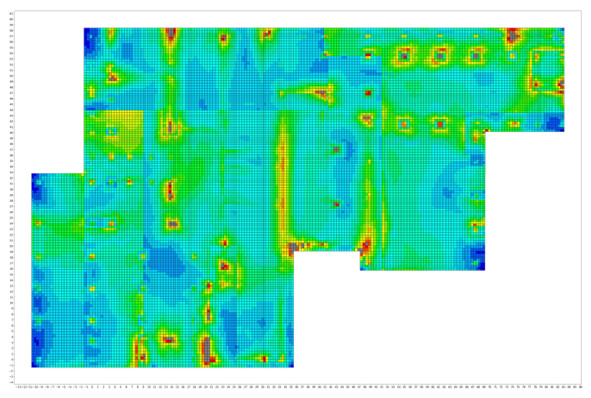
Optimisation visualisation for reinforcement design of a foundation slab for a nuclear research facility using the structural calculator. Red areas show reinforcement hot spots with other areas requiring less rebar.
Achieving 30% savings
Our work designing the MINERVA nuclear research facility in Belgium has been optimised by 30% through use of the structural calculator. The ability to quickly check the effects of changing different parameters by running them through the platform enabled the project team to immediately see the impact of various value engineering measures. The calculator made it possible to safely reduce the amount of reinforcement designed into the concrete base slab by 15% through analysis and adjusting the utilisation factor. This factor is a ratio of the predicted stress in the structure compared to the capacity provided by the reinforcement design. The visualisation tool allowed for observation of high utilisation hotspots, that ensured higher levels of reinforcement were maintained in these critical locations, without over designing the rest of the slab.
Without this validated proof, earlier methods would have maintained a more conservative level of reinforcement throughout the slab. Although this kind of optimisation can be done through conventional analysis, it would have taken months. Here, it took minutes.
Powerful proof
Early versions of the structural calculator were machine-based, but in 2024, its power was scaled-up by migrating to the cloud. Engagement with Mott MacDonald’s cyber security team, as well as with nuclear clients, was undertaken to ensure any data used and stored in the software was secure. Once assured that this was the case, the calculator was back-tested by running past project data through it.
The average time saving in civil and structural work was found to be 23%.
This streamlined efficiency empowers Mott MacDonald’s nuclear team to execute more projects and design iterations within the same timeframe. It improves optioneering capabilities and allows direct collaboration with colleagues, partners and clients to understand real-time design issues and achieve technical outcomes faster. Key learnings can easily be transferred between teams and projects, plus the use of a validated, standardised platform reduces the chance of human error. Another benefit of it being a centralised cloud-based platform is that updates, such as design code revisions, are consistently applied and cascaded to all users.
As a calculation delivery platform, the benefits of the structural calculator are so wide that it will bring advantages to other sectors too. It is also particularly well suited to critical infrastructure such as dams, hospitals, bridges and major buildings. Its transparent, validated format means it can be easily interrogated to test its capabilities to ensure client confidence ahead of adoption.

Sign-up here
Sign up for our Nuclear Know-How webinar series, designed for those who are solving nuclear’s biggest challenges. In February, March and April you can learn directly from Mott MacDonald specialists and clients as they share actionable approaches, new digital tools, and insights shaping the next generation of nuclear projects.
Register below to access all webinars and live discussions.


Subscribe for exclusive updates
Receive our expert insights on issues that transform business, increase sustainability and improve lives.