


Theme 2

- Theme 2
Quick take
Combined authorities and local authorities have been forced to bid within Whitehall for pots of funding intended to achieve specific - often politically expedient - goals. This limits their ability to think strategically about the money they need to deliver their long-term objectives. It may also lead to some large schemes being taken forward with only relatively lukewarm local support.
The system is wasteful and expensive. In 2018-19, approximately 32% of departmental grants were allocated competitively, with 88% of applications being rejected, causing unnecessary expense to competing bodies. Complexity over investment timeframes and reporting requirements of specific government funds only adds to the issue.
Access to competitive funding pots favours resource-rich authorities, which can increase disparities between places and limit growth in places of most need. Areas with deeper in-house expertise or the ability to spend more on specialist consultancy support tend to fare better.
Issues with Green Book process in prioritising areas of existing high demand exacerbate this problem; announcements from the Treasury that this is under review are, therefore, very welcome. As it stands, the need for upfront investment in transport infrastructure to support new housing developments is not properly represented in the business case process.
In short, greater devolution of responsibilities, powers and funding around the major strategic infrastructure enablers will not only save time and money but also unlock and direct development. Additionally, it will bolster support for local projects amongst local and regional stakeholders and the public.
Specifically, a move to more extensive - in scope and geography - “single pot” place-based funding would be highly welcome, as would greater flexibility to support more innovative funding models at a sub-national level.
Funding and financing
The English Devolution White Paper proposes to roll out Integrated Settlements across mayoral strategic authorities. In our view, this will lead to greater stability and certainty, which in turn should result in more effective delivery of the infrastructure and wider measures needed for local growth.
Integrated Settlements are funding arrangements that consolidate multiple funding streams into a single settlement for mayoral strategic authorities. The model builds upon the single funding settlement “trailblazers” announced for Greater Manchester and West Midlands combined authorities in the 2023 Spring Budget.
These settlements allow mayoral strategic authorities to bring together funds from across Whitehall departments in areas such as housing, transport, regeneration, skills and retrofit. These authorities can also move funding between years to meet investment commitments, improving prioritisation based on local needs and reducing waste and inefficiency. In addition, Single Integrated Settlements could reduce reporting requirements too.
More could be done to bolster the proposed Integrated Settlements. For example, while the English Devolution White Paper outlines plans for the “regionalisation” of Homes England, it is not clear that its affordable housing subsidies will be devolved in the short term. Returning to a common theme in our paper, this is an issue where local actors are likely to best understand what is needed and the complex interplay between developers, social landlords and other parties required to best deliver affordable housing in their area.
Moreover, the government should not stop at its current plans for Integrated Settlements. As the capability to manage big projects is built up in strategic authorities they could be given greater control over new infrastructure spending in their area, including on major projects that have traditionally been the preserve of Whitehall and, ultimately, the Treasury. It should be for mayors not national policy-makers to be the decision-makers – rather than merely advisors – on which regionally significant infrastructure investments are made in their area. In our vision, strategic authorities should have the confidence and remit to resist large projects if they can see that another approach would bring better long term outcomes for their region, rather than allow them to go ahead simply because they fear losing that scale of investment.
On this point, the relationship between strategic authorities, the new National Infrastructure and Service Transformation Authority, the proposed 10-Year Infrastructure Strategy, the National Wealth Fund, Great British Energy and related bodies should be urgently clarified. As we have said elsewhere, we believe that strategic authorities should have a formal role in these national policies and structures.
Case study:
Single pot trailblazers
The most radical approach to combined authority financing to date has been through the “Single Pot” funding schemes for the two devolution “trailblazers” in Greater Manchester and the West Midlands that were launched in March 2023.
Before this single pot system was tried, combined authorities relied on several different funding streams tied to specific policy areas or projects. Since the introduction of single pot funding, combined authority areas receive one funding settlement covering a whole spending review period. This allows greater long-term certainty and flexibility in the allocation of capital in line with local priorities.

Addressing brownfield viability
The viability of brownfield land remains one of the biggest challenges to densification of towns and cities in the UK.
Generally, stronger growth outcomes come from densification of existing places. A focus upon brownfield first, strategic sites, small sites, stalled sites and void housing will deliver a host of wider regenerative outcomes, particularly in regional cities.
However, there are significant viability issues for brownfield development in all core cities outside London, even as UK average house prices reach record highs.
Sites ripe for high density, sustainable development are often held back by the condition of brownfield legacy land. Remediation processes that aim to return the land to a clean and safe condition can be prohibitively costly, particularly as investment is incurred up-front. Adding the installation of new transport and energy infrastructure to this, as well as the requirement to meet wider national and local planning policy, further exacerbates the viability gap.
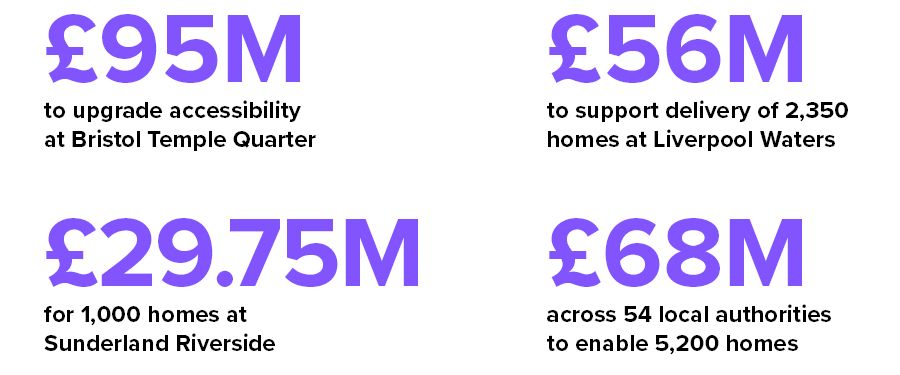
The viability challenge for urban regeneration schemes has long been recognised. Mott MacDonald has supported local authorities over many years to secure funding for the essential infrastructure needed to unlock growth, such as £95M at Bristol Temple Quarter to upgrade accessibility to the railway station and other transport works. In recent months, the government has announced a series of substantial funding packages to support acceleration of several major sites. These packages include £56M to support delivery of 2,350 homes at Liverpool Waters, £29.75M for 1,000 homes at Sunderland Riverside and £68M across 54 local authorities to enable 5,200 homes.
There is a broader need for innovative funding models to address viability gaps in brownfield development. Current funding support from government, which includes grant funding and commercial loans, are important tools, but are not enough to fully address the viability gaps in development projects.
The English Devolution White Paper commitment to introducing a Mayoral Community Infrastructure Levy (CIL) may help in some cases. This will work by offering a new funding source for mayoral strategic authorities and allowing surpluses from some developments to be recycled into less viable projects. The power to raise CIL will depend on instituting an SDS, allowing it to be raised for specific projects, in line with the powers of the Mayor of London.
However, more could be done. At present, the ability of combined authorities to provide more innovative financing solutions to developments is constrained. An example of these issues comes in statutory borrowing limits and the need for departmental or central government sign-off to take on significant loans or equity financing. Yet options such as provision of patient equity-type products have been shown to enable unviable schemes to proceed, as in the example of Stockport Interchange in Greater Manchester (see case study below). Greater flexibility and a willingness for strategic authorities to take on risk will not only spur development, but also allow for increases in value to be realised for the public sector through future disposals.
Case study:
Stockport Interchange
Stockport Interchange is an example of innovative funding mechanisms enabling successful completion of a regionally significant infrastructure project. Stockport Council provided patient equity investment alongside the Greater Manchester Combined Authority and property investment firm CityRise.
Early assessments of this project deemed it “unviable”. However, the confidence of Stockport Council and the Greater Manchester Combined Authority in the future value of the land has resulted in 200 new residential apartments, new bus stands, a park and active travel infrastructure that would not otherwise have been built.