
Technology drives creativity and quicker, more cost-effective projects. A step change for our industry.
See how we connect innovation to outcomes.
Expert insights on issues that transform business, increase sustainability and improve lives
Here’s a snapshot of what we’re thinking about. Explore these highlights or view the full library to dive deeper into the ideas shaping our work.
Meet some of our passionate problem-solvers, constructive creatives and inspiring innovators
We have been appointed by the Skanska-Traylor-Walsh joint venture as lead designer on the Second Avenue Subway Phase II project for the Metropolitan Transportation Authority (MTA). Our role focuses on the major design-build package covering excavation, tunneling, and structural shells for the future 106th Street Station and its connecting tunnels.
The 106th Street Station will be constructed at the intersection of 106th and Second Avenue and bring an ADA-accessible Q line stop to East Harlem, reducing commute times for residents of upper Manhattan, the Bronx, as well as residents commuting from the Hudson Valley via the Metro-North Railroad. The project also advances future connections to 116th Street and 125th Street/Lexington Avenue stations, linking the Q line with the 4/5/6 subway lines and Metro-North Railroad, and improving access for hundreds of thousands of daily riders.
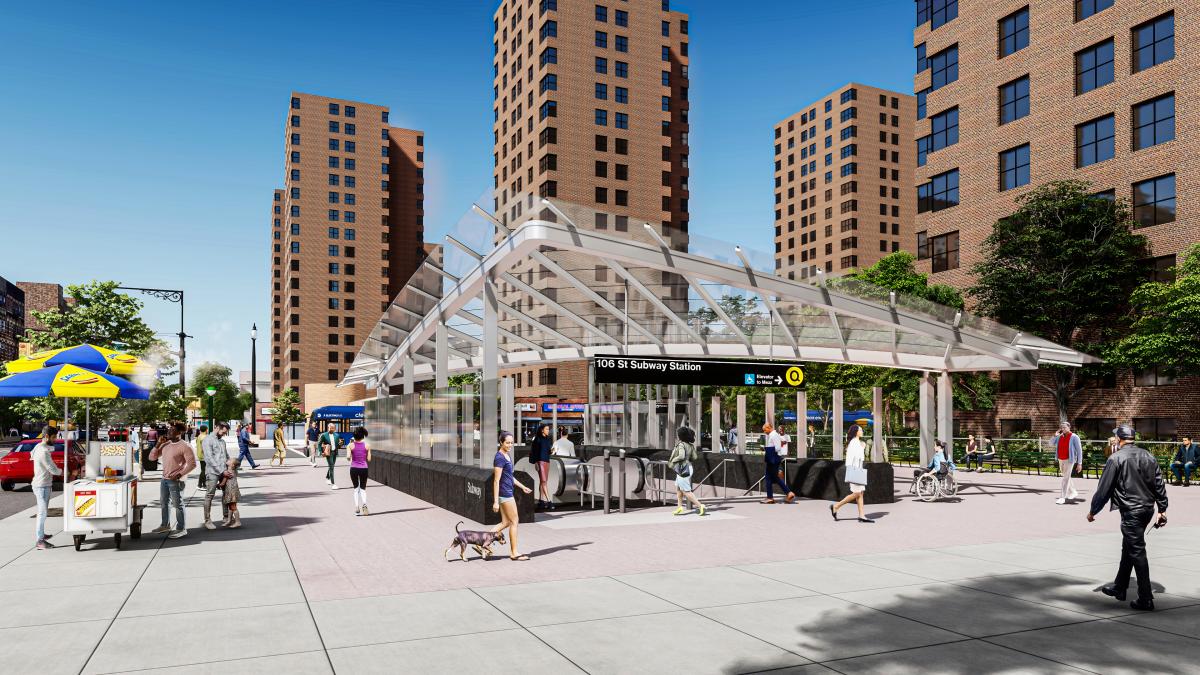
As a critical expansion of New York’s transit network, the project will help address long-standing transit gaps in East Harlem following the removal of the Second Avenue elevated line in the mid-20th century. By extending service and improving connectivity, it will ease congestion on the 4/5/6 lines, reduce pressure on local bus services, and improve overall system resilience.
We will lead structural design, coordinate multidisciplinary design efforts, support excavation and underground rehabilitation, assess adjacent structures, and manage electrical and environmental coordination with utilities and governing agencies. Frank Perrone, group leader for tunnels at Mott MacDonald, said, “Our experience working alongside some of New York’s leading transportation agencies has prepared us to support the MTA in expanding access and improving mobility for New Yorkers.”
The Second Avenue Subway Phase II project represents a major step toward a more connected, accessible and resilient transit system, supporting growing communities and enabling more efficient travel across the city. Construction is expected to reach substantial completion in the third quarter of 2030.
Over the past two decades, significant progress has been made in surface flood management. Cities have embraced floodable parks, deployable barriers, smart levees, and nature‑based solutions that deliver environmental and social value alongside flood mitigation.
With ever-changing and increasingly complex contractual model interfaces, proper understanding and allocation of the responsibility for construction impact assessments, risks, and instrumentation and monitoring is essential.
Project delivery has transformed significantly due to rapid advances in technology. Digital delivery is more than just a deliverable, it’s a strategic enabler that drives efficiency, innovation, and better outcomes.
To honor the three-year anniversary of its full service to Grand Central Station, we caught up with four of our tunnelling experts in New York as they reflect on their years of work on East Side Access.
We caught up with Sander to explore his career journey, the role of trust in leadership, and how curiosity shapes his approach to urban mobility.
We caught up with senior project engineer and tunnel ventilation lead Scott Shi to talk about the importance of Fire and Life safety and his experience working for Mott MacDonald around the world.
Wynton Habersham has joined Mott MacDonald as market leader for rail systems in the United States. In his role, he will lead the delivery of rail systems and train control professional services to clients in North America.
The new Line 6 Finch West LRT significantly improves connectivity for residents and commuters, easing congestion on major routes and providing thousands of daily riders with safe, reliable, and environmentally sustainable transportation.
At this year’s World Tunnel Congress (WTC) in Stockholm, Sweden, Mott MacDonald’s Randall (Randy) Essex was honored as an inaugural Fellow of the International Tunnelling and Underground Space Association (ITA).
The Ohio River Tunnel is the first of three combined sewer overflow (CSO) tunnels at the core of ALCOSAN’s Clean Water Plan.
The East Link Extension is a major expansion of Sound Transit’s light rail system, serving one of the region’s fastest-growing corridors and introducing the world’s first electrified light rail system to cross a floating bridge.
Mott MacDonald is supporting the Metropolitan Transportation Authority (MTA) in its goal to make 95% of New York City’s 472 subway stations ADA-compliant by 2055.
As Seattle prepares for significant population and job growth, the West Seattle and Ballard Link Extensions will add efficient light rail transit options to connect communities with reliable public transportation.
Toronto’s largest and most complex transport project to date, the Ontario Line, is being delivered under a combination of two large public-private partnerships and two progressive design-build contracts.