




Designing transit for women: lessons for inclusive mobility and transportation planning
Our transportation planning and advisory services team explores how women’s travel patterns differ from men’s across four North American cities.
Transit systems should be designed for flexibility and multimodal access as travel patterns among women often include more varied trip types than traditional commute patterns.
Better transit starts with better data. Transportation planners and agencies should use recent, disaggregated, and intersectional data to design systems that reflect how people move today.
Article
Transit planning for inclusive mobility
Women’s travel patterns, including frequency, distance, and time of day, have historically differed from men’s. These trends continue to evolve and remain important considerations for transportation planning across North America. By using regional survey data from metropolitan planning organizations, agencies can better understand these trends and help shape transportation systems to reflect the needs of all users, particularly women.
Using publicly available survey data from metropolitan planning organizations in Seattle, Chicago, and Philadelphia, as well as data from Ontario's Ministry of Transportation in Toronto, members of our transportation planning and advisory services team analyzed differences in travel and transit use between men and women. When examining the data, our team focused on gender-based travel variations alongside social factors such as race, income, trip purpose, household vehicle access, and residential location.
Eric Petersen, principal planner transportation, shares his findings, along with those of his colleagues, Addi Schmidt, scientist I environmental; Catherine Thibault, senior project manager; and Kimberly Green, principal project manager advisory. Their research highlights how a deeper understanding of women’s travel behavior can help agencies design transportation systems that are convenient, reliable, affordable, and comfortable for all users.

Identifying patterns in women's travel
Women make up the majority of travelers in each of the cities reviewed and the majority of transit riders in Chicago, Philadelphia, and Toronto. This finding aligns with a literature review by D’Agostino et al. (2024), indicating that women tend to travel more frequently than men. Our analysis identified the following key trends across the four cities:
- Lower-income women account for a larger share of transit riders than higher-income women. This confirms the importance of considering the needs of lower-income individuals when planning and designing systems.
- Women tend to travel more than men for non-work purposes. This pattern reflects differences in trip purpose, including leisure activities, shopping and escorting others.
- Women travel and take transit to work at rates similar to men. This trend, combined with evidence that women tend to take shorter trips in both distance and duration, indicates differences in travel patterns compared with the traditional 9-to-5, suburb-to-city commute that has historically informed the design of many transit systems.
- Households with no vehicle access and lower incomes have the highest transit shares. Women in one-car households in Seattle, Philadelphia, and Chicago are actually less likely than men to take transit.
Key demographic and geographic differences across metropolitan areas emphasize the importance of examining city-specific data in transit planning. This approach helps systems meet the needs of women across diverse groups rather than relying on broad generalizations.
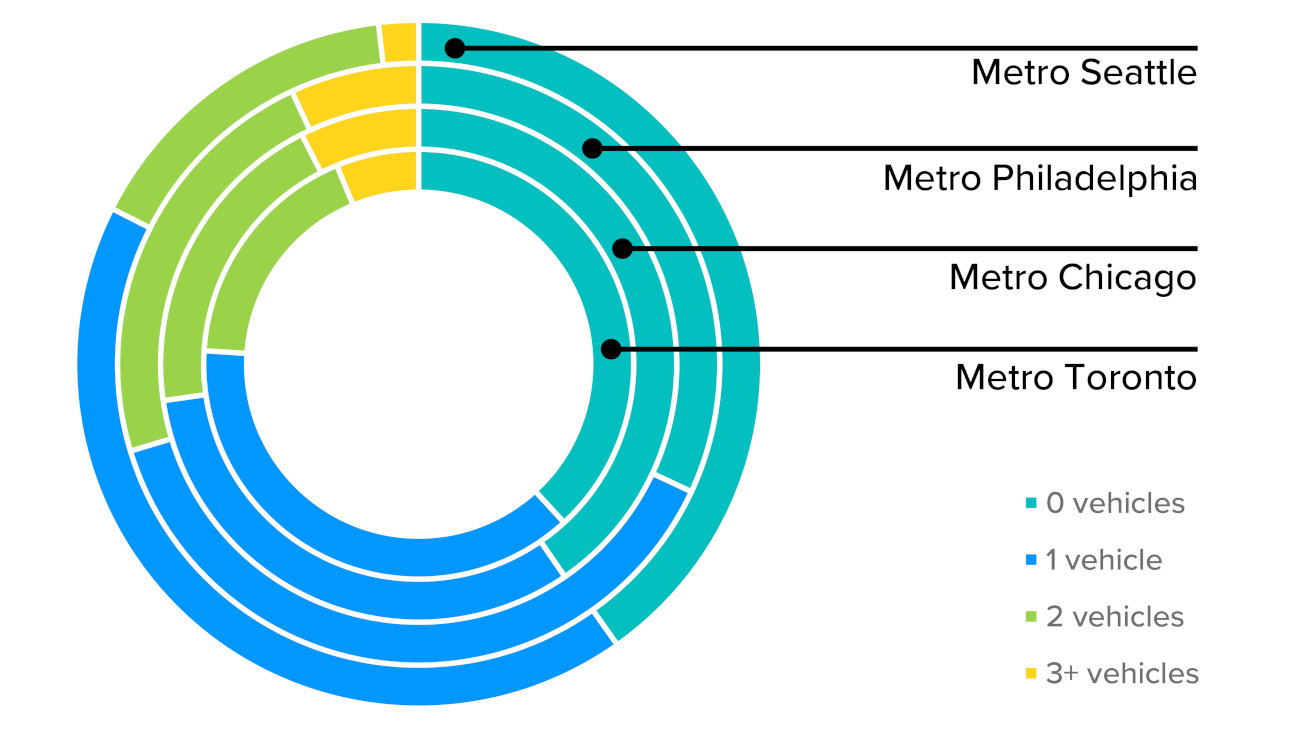
Female transit riders by household vehicles
These findings suggest that transportation systems designed around traditional commuting patterns may not fully reflect how many people travel today. Understanding these differences can help agencies make more informed planning and investment decisions.
Advancing inclusive mobility through data-driven action
As travel patterns continue to evolve, planners and agencies should move beyond static datasets and integrate recent, disaggregated data into decision-making. This includes tracking how telework, income, race and ethnicity, vehicle access, and location are reshaping travel demand, particularly as evidence shows women are more likely to work from home. Understanding these shifts is critical to designing services that reflect how people actually travel today.
To respond effectively, agencies should prioritize multimodal, flexible networks that better connect first- and last-mile journeys. Improving access to transit through walking, cycling, and shared mobility can help address the more complex, trip-chaining patterns (where multiple errands or activities are combined into a single journey) often seen in women’s travel.
Data alone is not enough. Agencies should embed gender-disaggregated and intersectional analysis into planning processes, using it to inform service design, scheduling, and investment decisions. This means designing systems that work for those most reliant on transit – particularly women with lower incomes, women of color, caregivers traveling with children, and older children traveling alone.

Multimodal solutions can improve first- and last-miles access to support greater public transit use
Safety is one of the most important factors influencing whether people choose to use transit. It should be treated as a core design principle rather than an afterthought. Improving lighting, visibility, and service policies (such as request stops at night) can directly influence whether women choose to use transit. A safe journey must extend beyond the vehicle to include stations, stops, and getting to and from transit connections.
Finally, agencies should adopt a more participatory and people-centered approach. Initiatives such as women-focused roundtables and increasing representation across the transit workforce can help shape services around lived experience. These insights lead to more responsive, comfortable, and inclusive systems.
Designing transit systems that work for women ultimately creates better transportation networks for everyone. Applying insights from gender-based travel behavior alongside integrated planning and engineering approaches supports the development of transportation systems that are more inclusive, accessible, and resilient.
Source: D’Agostino, Cecilia & Piva, Evila & Pucci, Paola & Rossi, Cristina. (2024). A systematic literature review on women’s daily mobility in the Global North. Transport Reviews. 44. 1-29. 10.1080/01441647.2024.2350613.
About the author

Subscribe for exclusive updates
Receive our expert insights on issues that transform business, increase sustainability and improve lives.