




Earlier involvement of communities in infrastructure is key to delivering government’s Pride in Place strategy
Local regeneration through Pride in Place is an opportunity for communities to create the vision for projects
Technology is a key enabler that encourages collaboration and monitors long term impact
Used responsibly artificial intelligence (AI) can widen participation and earlier exploration of different options
Article
Successful regeneration requires community-led vision
After contributing to a panel discussion between industry and government on Pride in Place, Mott MacDonald group director of external engagement Professor Denise Bower outlines how engaging communities earlier can support national renewal through well integrated infrastructure.
Professor Bower joined Secretary of State for Housing, Communities and Local Government Steve Reed and senior technical leader at Autodesk Bharat Gohil in a discussion hosted by Spectator editor and former Secretary of State for Levelling Up, Housing and Communities Michael Gove
Ten years ago, Holmfirth in Yorkshire was lucky enough to have the Tour de France ride through the community. Everyone was excited and local people really supported all of the developments that took place in the valley to enable it. This public enthusiasm surpassed all expectations and its legacy included increased tourism numbers and more people taking up cycling as a form of both exercise and transport.
Key to this success was that people knew what to expect. They had seen the Tour de France on television and they could visualise it and its impacts. But when it comes to major infrastructure projects and development schemes, which can generate transformational benefits for communities, people have had to try and visualise these from a drawing. For many this feels too abstract and too difficult to engage with.
The good news is that innovation in technology is really making a difference in terms of providing more information to communities earlier. Digital models give much better clarity over what is possible and crucially what these options might look like. This in turn is enabling greater local participation.
When people can understand the systemic effects of regeneration projects and engage with the trade-offs around cost, resilience and environmental impact, they develop a clearer understanding of the choices being made and a stronger sense of ownership. This leads to better investment decisions with projects that reflect local priorities, anticipate future consequences, lower risk and secure lasting public support.
Historically this has not been the case, with people being brought in too late, too often. The Pride in Place strategy which will see £5bn invested in 250 locations to build stronger communities over the next decade, along with the use of collaborative technology platforms, is an opportunity to change this. We have the potential for people in communities to be the co-authors of the story from the very beginning, putting their everyday environment at the heart of regeneration. As Autodesk’s senior technical leader Bharat Gohil remarked at the recent panel discussion hosted by The Spectator:
Technology is bringing transparency into a process where the community is defining the objectives, government is enabling the framework and industry makes it deliverable.
New approach for New Towns
Transparency and community engagement are particularly critical when it comes to building new homes. The government’s commitment to build 1.5M houses before 2029 partly depends on the success of its New Towns programme where 12 priority areas, each of at least 10,000 homes, have been investigated by the New Towns Task Force. Aware of the need for a systemic approach, the task force announced its intention to create well-connected, sustainable and attractive places where people want to live. To achieve this, it is crucial that the plans are formed by the communities themselves.
A recent report on planning for delivery of New Towns, sponsored by Autodesk, highlights what it calls a “vicious cycle of derailment” where schemes go through a “ping pong of rejections and changes”. The answer, it claims, is in digital reform of the planning system and the use of collaborative platforms where data transparency becomes the lever for change. The Ministry for Housing Communities and Local Government (MHCLG) is working on this via the Digital Planning Task Force but there is still some way to go.
The good news is that the political will is there and the tools are now more accessible. On this point Bharat explained that historically a user of complex design software would need to be a structural engineer or architect using a supercomputer, but access to these tools has now been democratised.
For example, today, with Autodesk Construction Cloud and our mobile app, we’re making project information more accessible so teams can review, collaborate, and make decisions from the field, right from their phone.
This widens access to more stakeholders and at Mott MacDonald, we know how effective it can be. As planning consultant for the 160km Grand Union Canal water transfer project we knew that a project with three owners spanning ten local authorities could present information management challenges. In undertaking the planning work required for a Development Consent Order (DCO) we introduced a single digital platform for land management, geospatial data and stakeholder engagement. This enabled collaboration and consistency and supported locally accountable decision making.
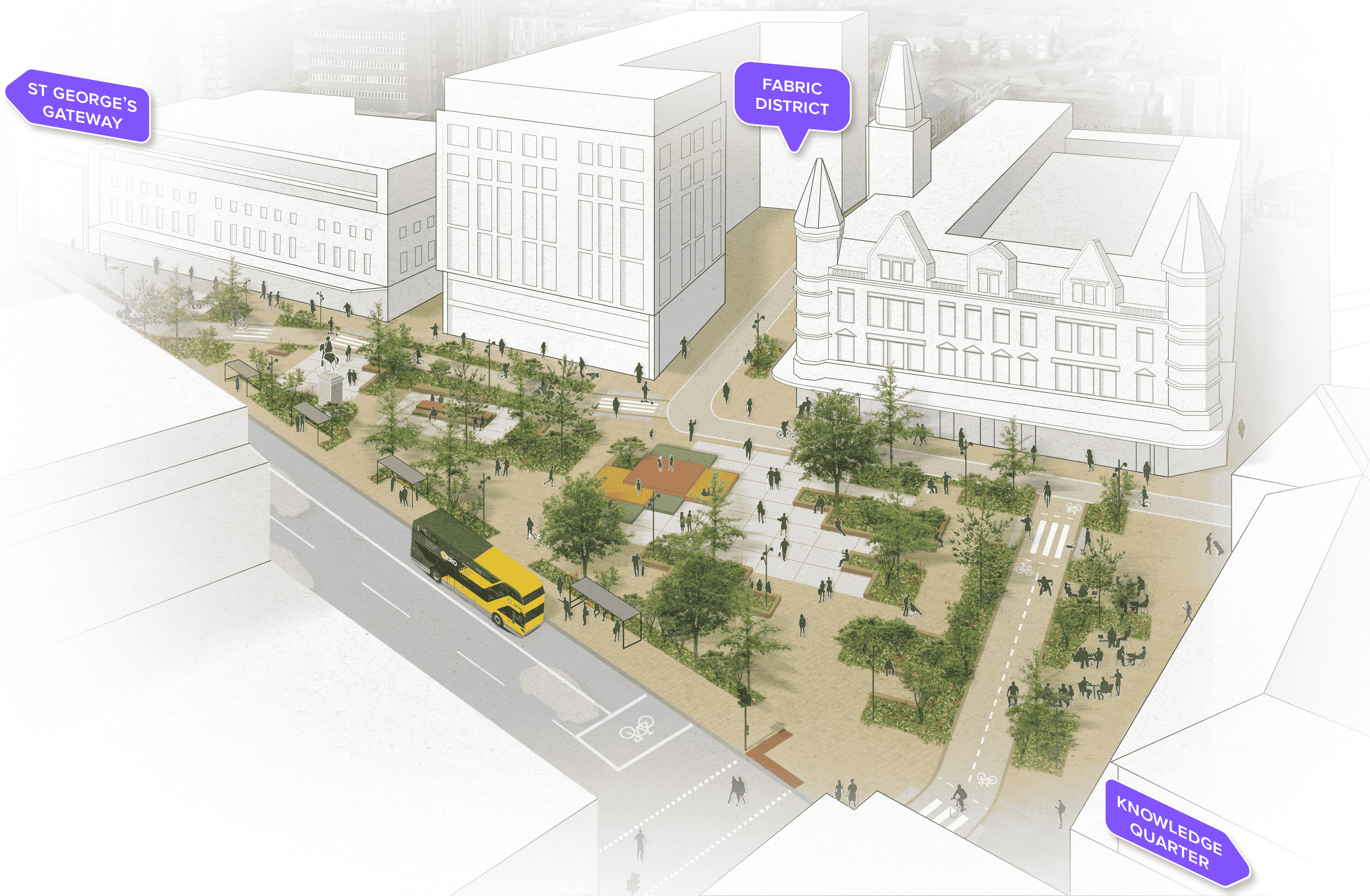
From a collaborative design perspective, we are seeing the value of co-creation on projects around the country. In Liverpool’s Fabric District we worked with local businesses and residents to co-design the transformation of a traffic-dominated gateway at Monument Place into an accessible civic space. In nearby Birkenhead we have worked with 62 local businesses to redesign the main high street area. Their concerns around vehicle access, pedestrian safety and anti-social behaviour directly shaped the design response which focused on what the community wanted – a more people friendly space.
Improving awareness with AI
Artificial intelligence allows us to take the transparency one step further throughout the project lifecycle. It can be used to:
- Analyse stakeholder feedback at scale more effectively, giving planners and designers more time to focus on the issues that really matter to people.
- Undertake wider appraisal of options and visualisation of these earlier, giving engineers more time to talk about solutions, understand systemic implications and weigh up the pros and cons with communities.
- Connect qualitative insight from local people with quantitative measurement to more accurately forecast economic outcomes of investment for a wider range of scenarios.
- Anticipate the impact of a multitude of future events when deployed predictively to analyse billions of data points. Extending this into the creation of digital twins enables full transparency through the operational life of the new infrastructure ensuring that the benefits promised are delivered.
Used responsibly with strong governance these types of digital innovation have the potential to transform delivery of regeneration and housing projects creating places that work for the people that live in them. By improving transparency, building trust, providing data driven insight and changing who is brought into the conversation when, technology can support the development of community led vision. Using technology to monitor the performance of local regeneration projects over time enables both investors and communities to see the long-term outcomes of projects, ensuring that, just like Yorkshire’s Tour De France, the legacy of investment lives on.
About the author

Subscribe for exclusive updates
Receive our expert insights on issues that transform business, increase sustainability and improve lives.